


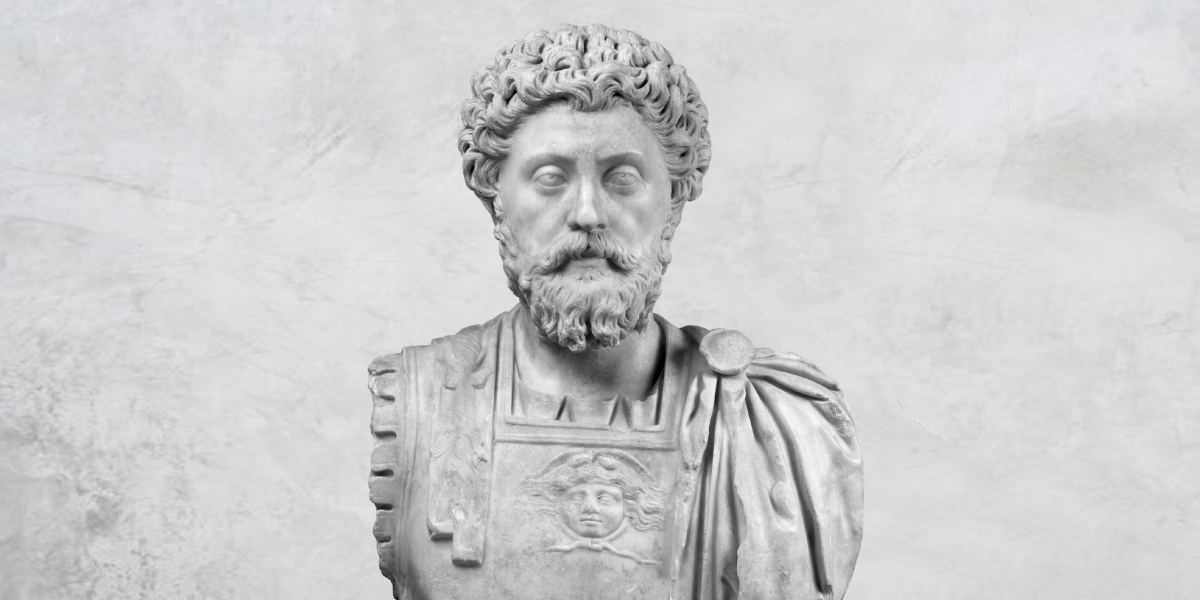
If you became a Roman Emperor, would you have maintained your humility? That’s one of the things Marcus Aurelius (121-180 CE), the “Stoic philosopher king”, was known for.
Adopted by his uncle, the Emperor of Rome, when he was a young man, Marcus spent his adult life learning the business of government, including serving as consul (chief magistrate) for three separate years.
Prior to becoming Emperor, Marcus also began forming an interest in philosophy. In particular, the writings of the former slave Epictetus (55 BCE–135 CE), a renowned thinker of Stoic moral philosophy. This would turn out to be the influence of one of Marcus’ greatest legacies, the Meditations.
Meditations and Stoicism
The Meditations of Marcus Aurelius is a series of twelve books containing personal notes and ideas for self-guidance and self-improvement. Scholars believe it’s unlikely that it was ever written to be seen, but rather that the books are akin to a journal, written in private for his own moral improvement, to reinforce in himself the Stoic doctrines that he aimed to live and rule by.
Marcus wrote these meditations during the second decade of his reign and last decade of his life, during which he was campaigning to take back and expand parts of his empire after enduring years of plague and invasion.
He saw the philosophy of Stoicism as the principal guidance for his life and writing, though quotes from many other philosophies can be found in his books.
Stoicism is an ancient philosophy whose ethics propose a focus on reason and happiness (flourishing). It says, like many philosophies at the time, that the rational person’s ultimate goal is to live happily.
Unique to Stoicism, though, is the idea that the only thing needed for happiness is virtue. To live perfectly virtuously is to be happy, regardless of external constraints or effects. This leads to a difficult conclusion, but one that the Stoics maintain: a virtuous person being tortured for example, is still maximally happy, since they still possess the one beneficial quality, virtue.
It follows from this, say the Stoics, that happiness is fully within our personal control. Marcus’ writing to himself reinforces this idea in various ways, supporting himself through the difficulties of Roman life, not to mention a ruler during conflict.
“Such as are your habitual thoughts, such also will be the character of your mind; for the soul is dyed by the thoughts.”
One of the main teachings of Stoicism is acceptance. This is where the common misunderstanding of Stoicism being restraint comes from. Many believe that it encourages the bottling or rejecting of emotion. Rather, it says that virtuous people are not overcome by impulsive and excessive emotion.
This is not because Stoics believed that we must restrain ourselves. Instead, they believed that we find virtue through knowledge. Then, once we properly obtain the knowledge that coincides with our rationality and nature, we will freely accept the reality of things that once may have caused us grief (or joy).
“If you are distressed by anything external, the pain is not due to the thing itself, but to your estimate of it; and this you have the power to revoke at any moment.”
Marcus used these teachings to guide himself, as is evident in the many quotes that continue to circulate in pop culture. Some of these speak of the importance of endurance in the pursuit of virtue, believing that challenges are an opportunity to strengthen character. Others speak of the importance of gratitude in responding to the perceived highs and lows of life.
“Do not indulge in dreams of having what you have not, but reckon up the chief of the blessings you do possess, and then thankfully remember how you would crave for them if they were not yours.”
Marcus Aurelius left a legacy that has lingered across cultures and centuries to continue guiding people on their journeys of self-improvement.


BY The Ethics Centre
The Ethics Centre is a not-for-profit organisation developing innovative programs, services and experiences, designed to bring ethics to the centre of professional and personal life.
Ethics in your inbox.
Get the latest inspiration, intelligence, events & more.
By signing up you agree to our privacy policy