


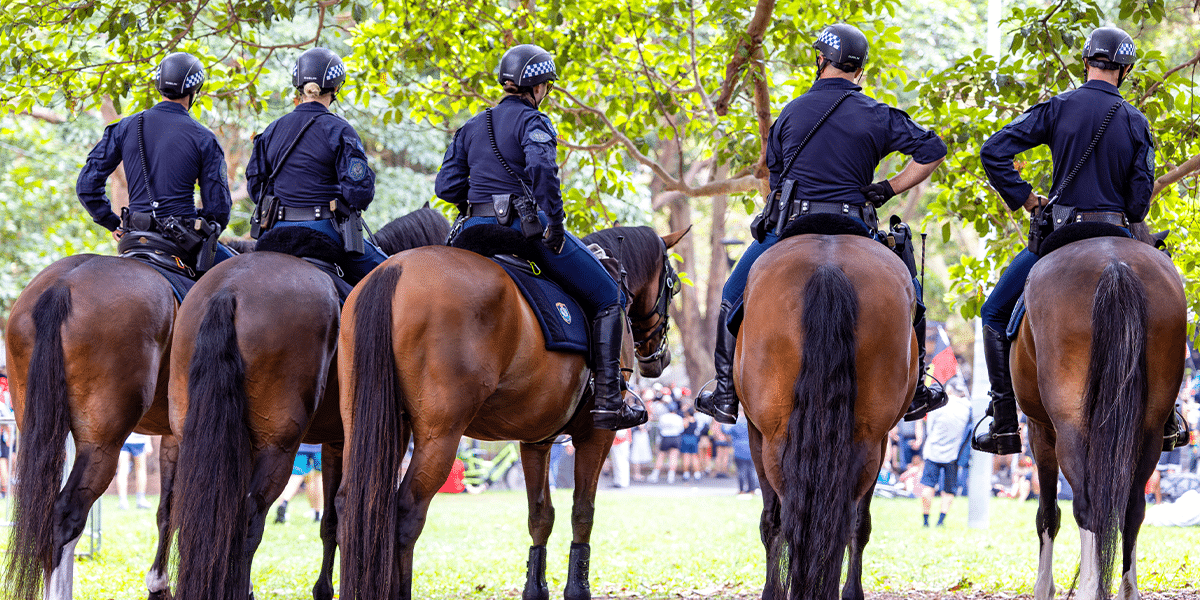
I was not there when police confronted people at Sydney Town Hall, protesting against the visit of Israeli President Herzog. So, the best I can do is offer a way of assessing what took place – once all of the evidence is before us.
A fundamental principle of policing is that it is most effective when practised with the consent of the community. With that consent in hand, police are accorded extraordinary powers that may not be exercised by ordinary citizens. Those powers include the right to use force in the discharge of their duties. However, these are not ‘unbridled’ powers. Rather, the use of force is hemmed in by a series of legal and ethical boundaries that must not be crossed.
The application of such boundaries is especially important when police are authorised to use lethal force. However, whether armed or not, the ethos of policing is supposed to be conditioned by two fundamental considerations.
First, all police in Australia exercise what is known as the ‘original authority of the constable’. This is a special kind of authority intended to ensure that police uphold the peace in an even-handed manner, without regard to a person’s wealth, status or office. Originally conceived in medieval times, it ensures that all are equal before the law. One aspect of this ‘original authority’ is the right (or, perhaps, the duty) to exercise discretion when employing the special powers conferred on police. It is for this reason that there is a general expectation that police should warn rather than punish people when that would be sufficient to achieve the proper ends of law enforcement.
And what are those ends? To the surprise of many (including some police) the role of policing is not to apprehend criminals so that they may be brought before the courts. Nor is it simply to ‘enforce the law’. Both of those elements of policing are important. However, they are in service of a more general purpose which is to uphold the legal and moral rights of citizens (only some of which are codified in law). This is why society frowns on the actions of those rare police who, say, plant evidence on a suspect in hope of proving their presumed guilt. You cannot uphold the legal and moral rights of citizens by violating the legal and moral rights of citizens! It is only when police act in a manner consistent with their overarching purpose that the community extends the trust required for policing to be maximally effective.
The main point to note here is that the best way to prevent crimes and other harms is for communities to be intolerant of those who engage in harmful (and especially criminal) conduct. In turn, the communities that most trust their police are also those most intolerant of crime and other antisocial behaviour. For the avoidance of doubt, let me make it clear that I do not consider peaceful protesting to be ‘antisocial behaviour’. Rather, it plays a vital role in a vibrant democratic society.
The second basic fact that conditions policing is related to the asymmetry of power between police and citizens. The most obvious sign of that asymmetry is that, with only a few exceptions, only police may be armed in the course of daily civic life. However, with great power comes great responsibility. In this case, the use of force, by police, must be proportionate and discriminate. That is, force may only be applied to the minimal degree necessary to secure the peace.
Policing is dangerous work. But beyond the risk of physical harm, police are often taunted and insulted – especially by seasoned provocateurs who are trying to bait police to lose control. That is why police require training to resist the all-too-human tendency towards self-protection or retaliation. Again, this is essential to maintaining community trust and consent.
The public needs to be convinced that police have the training and discipline to apply minimal force – no matter what the provocation.
Given all of the above, what questions might we ask about the way police engaged with protesters gathered at the Sydney Town Hall? Did police exercise discretion in favour of the citizens to whom they are ultimately accountable? Was their use of force discriminate and proportional? Did the police exercise maximum restraint – no matter what the provocation?
As to where we might go from here, I think that we would all be well served if the politicians who set the laws within which police operate and the leadership of NSW police all stopped for a moment to ask, “Will the thing we next do build or undermine the trust and consent of the community as a whole?”.


BY Simon Longstaff
Simon Longstaff began his working life on Groote Eylandt in the Northern Territory of Australia. He is proud of his kinship ties to the Anindilyakwa people. After a period studying law in Sydney and teaching in Tasmania, he pursued postgraduate studies as a Member of Magdalene College, Cambridge. In 1991, Simon commenced his work as the first Executive Director of The Ethics Centre. In 2013, he was made an officer of the Order of Australia (AO) for “distinguished service to the community through the promotion of ethical standards in governance and business, to improving corporate responsibility, and to philosophy.” Simon is an Adjunct Professor of the Australian Graduate School of Management at UNSW, a Fellow of CPA Australia, the Royal Society of NSW and the Australian Risk Policy Institute.
Ethics in your inbox.
Get the latest inspiration, intelligence, events & more.
By signing up you agree to our privacy policy