

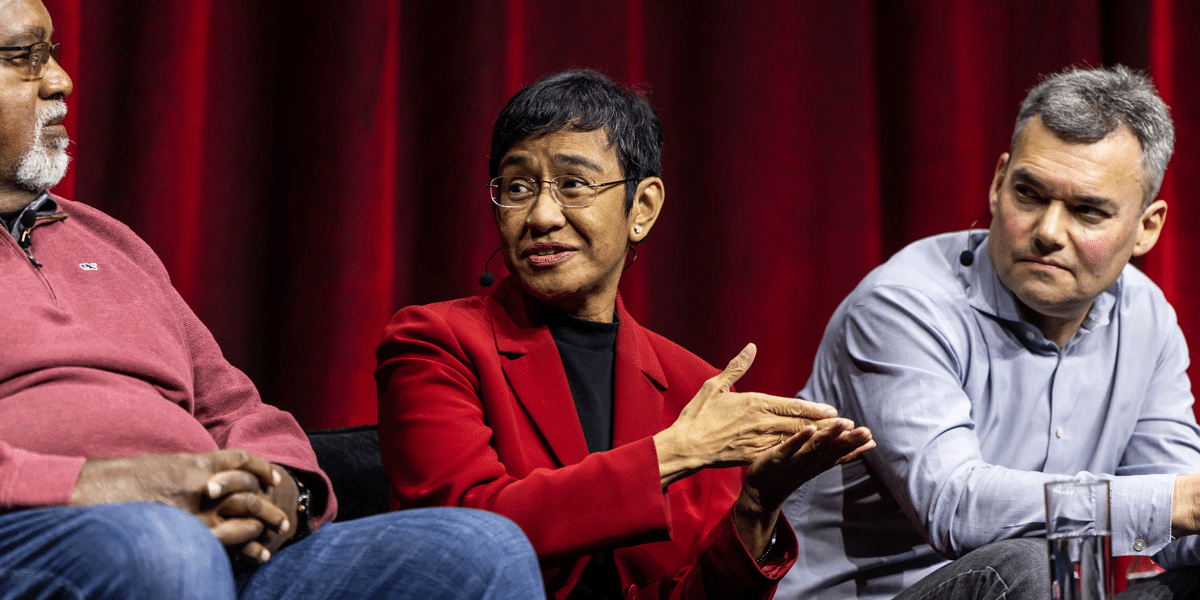
Across 10 days, 13 iconic venues and 115 sessions this year’s Festival of Dangerous Ideas explored hatred, belonging, nationhood, conspiracy, faith and equality.
Here are 5 things we learnt from the Festival in 2026:
You cannot have agency if you live in an environment where you are insidiously manipulated
Filipino journalist and 2021 Nobel Peace Prize laureate Maria Ressa argues the rise of Donald Trump and populist authoritarians worldwide is no anomaly. It’s the product of an information ecosystem built to amplify the worst of our nature, and divide and manipulate us. Data shows Trump, Jair Bolsonaro and Rodrigo Duterte likely wouldn’t have been elected without algorithms boosting their visibility and credibility. Platforms built to keep us scrolling let lies outrun facts, and AI is compounding the problem, crowding out trusted human sources altogether. Without a check on power, authoritarianism walks through unchallenged – and Ressa warns the same could happen here, in Australia.
We must get off the big tech platforms and move to “public interest tech”, such as her own Rappler news website and other sites run by the people, not by tech billionaires. Rebuilding trust means choosing real conversations with real humans over algorithms designed to keep us apart.
The greatest wisdom is crossing the distance to listen
In a packed room, Jewish-American journalist Peter Beinart opened his session Facing Moral Wreckage with an unexpected expression of gratitude – not for those who agreed with him, but for those who didn’t. “Equality is the antithesis of bigotry,” he says, and he extends that principle even to those he disagrees with most. In a world where we increasingly curate our information feeds and conversations to confirm what we already believe, Beinart argues the most radical thing we can do is choose to listen to someone we disagree with. “The people who go the furthest distance to listen to different points of view show the greatest wisdom.”
We didn’t lose our privacy, it was taken at scale
Digital rights activist Cory Doctorow unpacks the forces driving the “enshittification” of the platforms we’ve come to rely on – and how far the rot now reaches.
Take “algorithmic wage discrimination”, where American hospitals, keen to avoid unionised staff, increasingly contract nurses through apps that act as an “Uber for nursing.” Before a nurse accepts a shift, the app checks a data broker for their credit card debt. And the more they owe, the lower the wage they’re offered. These apps exist to strip away workplace protections and squeeze workers down to the lowest wage they’ll accept, Doctorow says – and the privacy invasion that makes it possible is entirely legal. Labour protections are weak, but privacy protections are weaker.
This isn’t an accident, Doctorow argues, but the result of a concentrated, wildly profitable surveillance industry that has monetised the abuse of human rights at scale – drawing a direct line from Silicon Valley to nurses whose wages shrink because they can’t make a credit card payment.
“Tech companies aren’t spying on you because privacy is dead. Google spies on you for the same reason a dog licks its balls: because it can, and no one makes them stop.”
The banality of equality is what makes it dangerous
Equality requires us to fully recognise how much we have in common with even those very different or very far from us. Professor of history and author Ussama Makdisi says that this very simple concept is so self-evident that it is often completely overlooked.
The Middle East, as it is known in the Western world today, is too often seen through the lens of turmoil, religious fundamentalism, war, endless conflicts – but, Makdisi urges us to realise, this is both a harmfully reductive characterisation of the region today and a historically inaccurate characterisation of the region’s history.
By drawing on the intrinsic humanity of the people in these regions, Makdisi shows they had both a richer and more peaceful co-existence prior to colonisation. If we are to ever to reach relative peace again, we must be truthful about this past and recognise the way that populations are dehumanised through ahistoric cultural representations.
Not all dangerous ideas are easy to see
Many people expect danger to come from the furthest fringes of politics or culture, or to immediately outrage us. But we live in a rapidly changing world, filled with overlapping crises, competing truths and profound uncertainty – one where the forces shaping our lives are increasingly interconnected and difficult to see.
This year’s program expanded beyond talks and panels, and into arts, films, excursions and banned books – showing how real danger lies in confronting the world as it is, rather than as we would like it to be. It means resisting simplistic narratives and probing beneath the surface. It means recognising that we may inhabit the same world while experiencing it in radically different ways.
As Festival Director Danielle Harvey says: “The most dangerous ideas are not the ones that offend us – it’s the ones we are wilfully ignoring.”
Catch up on select 2026 sessions, on demand now.
Photo by Ken Leanfore


BY The Ethics Centre
The Ethics Centre is a not-for-profit organisation developing innovative programs, services and experiences, designed to bring ethics to the centre of professional and personal life.
Ethics in your inbox.
Get the latest inspiration, intelligence, events & more.
By signing up you agree to our privacy policy