

As a 16-year-old, I argued with my vegan friend about the various faults in his logic: how he couldn’t possibly be healthy, how we were meant to eat animals, and all the rest. I never could have imagined how embarrassed it would make me many years later.
I wasn’t particularly familiar with veganism as a teenager, but I have always loved animals. While the fervour to prove it wrong dissipated, my knowledge and exposure to it remained very minimal, like most people’s. A little later, I briefly dated someone who was vegetarian, who inevitably but mostly passively increased my exposure and knowledge. I decided to start looking into the validity of my confident preconceptions and realised that they were either completely unfounded or just exaggerated. It wasn’t many years later when I woke up in the middle of the night and decided that I needed to change my actions.
Veganuary
Coincidentally, 2014 was the year that I began changing my lifestyle to better reflect my values – the same year that a British nonprofit began an annual challenge called Veganuary: a call for people to try eating as if they were vegan for the first month of the year. You sign up for free and are provided with daily emails for a month that include information like recipes, cookbook pages, meal plans and general advice for how to navigate the change in habits.
All of this is well and good if you’re already curious about the idea of reducing your animal consumption, but what if you’re not? Let me try and pique your curiosity.
Why you should care
You might already consider yourself someone who cares. Most people do love animals in theory. If you see an injured bird, a run-over kangaroo, or an abused dog, you’re likely to have a compassionate response. But decades of socialisation, billions of dollars in misrepresentative marketing, and the ever-increasing distance between consumers and production means it’s easier than ever to ignore how our values contradict our everyday actions.
So please indulge me by considering the following responses to common arguments for eating animals.
To begin, let’s get the practical stuff out of the way:
Where will I get my protein? We need meat/dairy/eggs to give us all the nutrients we need.
This argument is as unfounded as it is ubiquitous, and one I wasn’t immune to earlier in my life either. Unfortunately, agricultural lobbying groups are much better at getting into the minds of average consumers, otherwise it would be common knowledge that all major dietetic associations agree on the safety (and benefits) of balanced vegan diets (and all types of vegetarian diets). That’s not to demonise the health of any other kind of balanced diet – you can be perfectly healthy on a regular omnivorous diet – but the ethical argument for showing compassion to animals doesn’t require it to be healthier than eating animals, only that it’s not bad for us. The overwhelming evidence shows that it is not.
The question is not “can I?” but “how would I like to?” That’s why something like Veganuary is such a good introduction, because having the initial support to change your shopping and eating habits makes the transition much easier.
It’s too hard.
Maintaining a balanced omnivorous diet is also too hard for most Australians – doesn’t mean you shouldn’t try! Sometimes we have to do difficult things for our own good or the good of others. You will likely find though, as I did, that the hardest part of changing your lifestyle is the social aspect. People can be judgemental, defensive, aggressive, and downright cruel despite your best attempts to minimise the impact that your choices have on others. Contrastingly, changing habits can be difficult in the short term but they soon become second nature. Staple recipes are easily replaced and substituted with similar-tasting alternatives.
Okay so maybe it won’t make my life worse personally, but it’s so bad for the environment. All those almond trees and soy crops use so much water and cause deforestation. We need animals to feed everyone.
Almond water usage obsession arose initially during the early-mid 2010s Californian droughts, where the majority of the world’s almonds are grown, at a time when almond consumption was skyrocketing. I’m not going to rush to almond’s defense, as we should definitely be prioritising mass consumption of soy and oat milk instead, but if we do want to compare it to the animal-derived alternative then almond is still better, using almost half the amount of water and causing almost five times less CO2 emissions.
The idea that the soy used for soy milk, tofu, tempeh, etc is driving deforestation is another common myth:
“In fact, more than three-quarters (77%) of global soy is fed to livestock for meat and dairy production. Most of the rest is used for biofuels, industry, or vegetable oils. Just 7% of soy is used directly for human food products such as tofu, soy milk, edamame beans, and tempeh.”
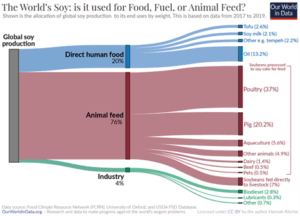
Even further than this, the amount of land cleared for cow pastures is over 7 times that for total soy production. If you’re worried about the environment, reducing or eliminating your animal consumption is the best place to start.
I’ve heard that farming vegetables kills more animals (mice, insects, etc) than eating meat, so if we care about animals, we should really keep eating them.
As we’ve seen, most of these crops go to feeding farmed animals, which means that it is still much preferable to consume these crops ourselves, rather than producing magnitudes more to feed other animals to be killed. The same logic applies if you’re someone who would like to argue that plants have feelings, too.
If you’d like to read more about the arguments against veganism, please see here.
Starting the year right
The overarching consideration here from an ethical standpoint is to reduce unnecessary suffering. For me, this comes mainly from a consequentialist perspective. Suffering is bad, we want to see and contribute to less of it. Eating meat, dairy and eggs necessitates immense amounts of unnecessary suffering and death (even if you think killing an animal that lived a good life is okay, we cannot feed the world with that kind of production – factory farms exist to fill the demand). Therefore, we should stop contributing to that demand.
My suggestion isn’t to make a permanent change overnight, but simply to try something new. You can join millions of other people around the world who are trying out a month of reduced animal harm through Veganuary. Or maybe you’re someone who says things like “I could go vegan except I love cheese too much”. Well, use the start of this year to try being vegan except for cheese. You’ll probably find that the hardest part of doing good is taking the first uncomfortable step.

BY Daniel Finlay
Daniel is a philosopher, writer and editor. He works at The Ethics Centre as Youth Engagement Coordinator, supporting and developing the futures of young Australians through exposure to ethics.
Ethics in your inbox.
Get the latest inspiration, intelligence, events & more.
By signing up you agree to our privacy policy