


Ethical by Design: Principles for Good Technology
Ethical By Design: Good Technology Principles for AI
Learn the principles you need to consider when designing, deploying and governing AI technology responsibly.
When The Ethics Centre first published its Ethical by Design principles in 2018, artificial intelligence was still largely confined to research labs and industry conversations. Today, it is embedded in everyday life.
While the core principles remain unchanged – that technology must respect human dignity, anticipate harm, and serve a genuine purpose – the context in which they operate has transformed. Artificial intelligence is no longer a future possibility. It is already shaping decisions, distributing opportunities, and influencing lives at scale. This shift demands more than technical capability. It requires ethical clarity.
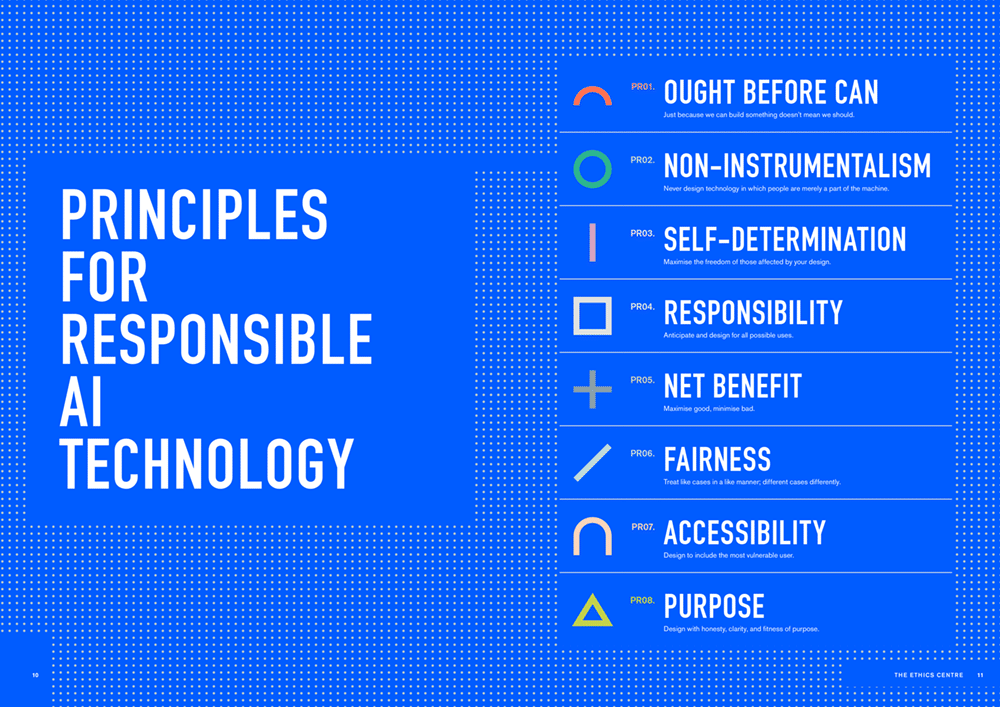
Ethical by Design: Good Technology Principles for AI responds to this moment. Building on The Ethics Centre’s original 2018 framework, the report sets out eight principles to guide organisations, policymakers and practitioners in the responsible design, deployment and governance of AI.
Grounded in real-world risks – including bias in decision-making, opaque algorithms, environmental impacts, and the misuse of generative technologies – the framework pairs each principle with practical actions for implementation.
For organisations navigating whether and how to deploy AI, this is more than a compliance checklist. It is a tool to test assumptions, sharpen judgement, and support more responsible decision making.
If you’d like to discuss implementing ethical AI in your organisation, contact consulting@ethics.org.au.
“These aren’t technical questions to be solved through better engineering. They’re profound ethical questions about the kind of world we want to live in, and the kind of future we choose to create.”
WHATS INSIDE?

Core ethical design principles

Case studies + ethical breakdowns

Design challenges + solutions

Practices for implementation
Whats inside the guide?
PREVIEW THE GUIDE

AUTHORS
Author

Aubrey Blanche
Aubrey Blanche is, at heart, a deep thinker who refuses to believe that we cannot choose to build a world better than the one we’ve inherited. Her academic studies have always focused on understanding the causes of harm to the most vulnerable, and have included research on terrorism, defense contracting and military strategy, and the impact of AI applications on queer and disabled users. She spent more than 13 years in multinational technology companies advising on issues of organisational responsibility before joining The Ethics Centre as Director of Ethical Advisory & Strategic Partnerships. She is an advisor to global organisations seeking to scale in an ethical way, with an emphasis on equitable talent practices, justice-aligned ESG approaches, and responsible AI governance. She is a regular writer and speaker on issues of ethics in business, finance, and technology and a masters student in AI Ethics and Society at the University of Cambridge.
DOWNLOAD A COPY