


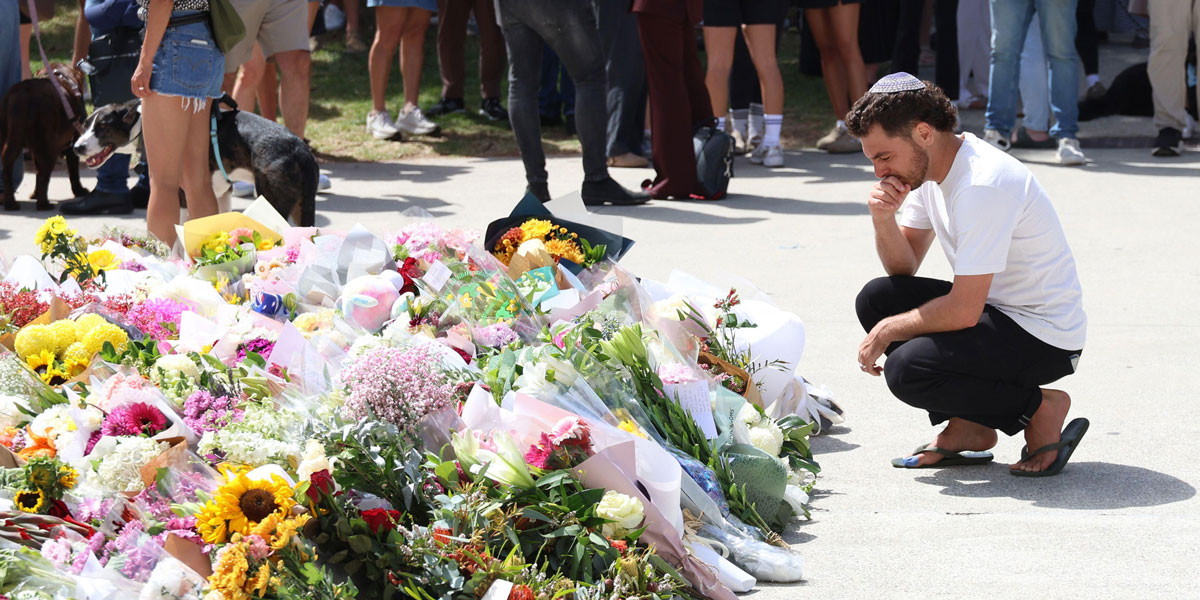
The emotions we feel in the wake of a tragedy, like the Bondi Beach shooting, are as intense as they are natural. What matters is how we act on them.
It was a typical relaxed summer Sunday evening. We had just finished dinner and I was on the couch watching TV while my wife was in the other room catching up with family over a video call. Then a wayward notification caused me to idly glance at my phone. A headline popped up on the screen, I caught my breath and switched on the news.
And in a matter of moments, the peace was shattered as the news came in that two men had opened fire on a group of people enjoying their own relaxed summer Sunday evening celebrating Hanukkah on Bondi Beach. A wave of emotions followed: horror, grief and outrage, followed by a gnawing sense of uncertainty. Were any of my friends or family there? What could drive someone to commit such an atrocity? Is anywhere safe?
These are typical emotions when confronted by sights such as these. The feelings well up from our bellies, fill our chest, overwhelm our minds. They are as primitive as they are potent. And they demand closure.
Yet emotions like these can be channelled in many different ways. Some forms of emotional closure are healthy. But other courses can end up causing more harm, either to ourselves or to others. And while it is easy to let these types of emotions consume us, it is crucial that we act on them ethically.
Horror and hope
Many creatures experience fear. It is a natural response to threat, and a potent motivator to remove ourselves from its presence. But our species is unique – as far as we know – in our ability to experience horror. Horror is also bound up with shock, disgust and dread. It is a response to the most acute violations of our humanity. The thing is, we don’t only experience horror when we are under threat, but when someone else is threatened. Underneath horror is a recognition of our shared sacred humanity and a revulsion at its desecration.
The problem is that the sense of horror triggered by an attack such as that at Bondi Beach on 14 December 2025 can change the way we see the world. In our aroused state, we become hyper vigilant to cues that might indicate future threats. And those cues will be associated with the location of the shooting, perhaps making us reluctant to go to Bondi Beach, or even causing us to fear going out in public at all.
If we allow emotion to take over, it can make the world feel less safe and other people seem more threatening.
But that response overlooks the fact that, despite the magnitude of the atrocity, this is an incredibly rare event perpetrated by only a few people. The fact that our feeling of horror is shared by millions of others around Australia and the world should serve as a reminder that the vast majority of us care deeply about our shared humanity, and it is those people that make the world safe. Should we retreat from the world out of fear, we do ourselves, and every decent horrified person around us, a disservice.
Following horror might be an overwhelming grief at the pain and suffering inflicted upon innocent people. This grief can lead to a feeling of powerlessness and despondency, one that again nudges us to retreat from the world. But, as painful as it is, our grief is proportional to our love. If we didn’t care for the lives of others – even people we have never met and will never know – then we wouldn’t feel grief. So we needn’t let grief strip us of our agency. Instead, we can let it remind us to lean into love and motivate us to reach out to others with greater patience and understanding.
A fire for justice
Possibly the most dangerous emotion in this list is outrage. This is another primitive emotion that motivates us to correct wrongdoing and punish wrongdoers. Outrage demands satisfaction, but it’s often not fussy about how that satisfaction is achieved. Great evils have been committed at the hand of outrage, and great injustices perpetrated to satisfy its call.
We must acknowledge when we feel outrage but be wary of its call to immediately find someone to blame and punish. Within an hour of the shooting, the media was already mentioning a name of one of the attackers, feeding the audience’s hunger for justice. But in its haste, it caught up an innocent man who then experienced unwarranted threats. Others rushed to blame the authorities for failing to prevent the attack or refusing to combat antisemitism.
Even when things look clear at first glance, we must remind ourselves that it’s all too easy to blame the wrong person or seek punishment just for the sake of satisfaction. And sometimes there is no one person to blame. Sometimes the causes of an atrocity are complex and interlaced. Sometimes there were multiple causes and nothing anyone could have done to prevent it. So we must temper outrage with a deeper commitment to genuine justice, lowering the temperature and working to understand the whole picture before calling for punishment.
I acknowledge that it can be difficult to pause in the heat of the moment, especially when we only have a fragmentary grasp of what’s going on and what caused it.
In times of uncertainty or ambiguity, we crave clarity and certainty. We seek out and latch on to the first available narrative that seems to make sense of a great tragedy. We like the feeling of being certain more than we like doing the work to interrogate our beliefs to ensure they warrant certainty.
We thus have a tendency to be drawn to narratives that align with our pre-existing beliefs or biases. Uncertainty and ambiguity can be like a Rorschach test. The patterns we see tell us more about ourselves than reality. If we don’t want to exacerbate injustice by generating or sharing false narratives that can cause real harm, we need to learn to sit with the uncertainty and dwell in the ambiguity. We are not naturally inclined to do so, but that only means we need to practice getting better at it.
The very fact we typically experience emotions like horror, grief, outrage and uncertainty speak to our deeper humanity. They speak to how much we care about others and living in a world where everyone deserves to be safe and thrive. If we allow the better angels of our nature to rise to the surface, and resist the temptation to satisfy our emotions in ways that cause more harm, we can respond in a genuinely ethical way.
Image by ZUMA Press, Inc / Alamy


BY Tim Dean
Dr Tim Dean is a public philosopher, speaker and writer. He is Philosopher in Residence and Manos Chair in Ethics at The Ethics Centre.
Ethics in your inbox.
Get the latest inspiration, intelligence, events & more.
By signing up you agree to our privacy policy