It’s only a fool who pretends that they could have predicted that Philip Zimbardo’s infamous psychological study, the Stanford Prison Experiment, would one day end up as a reality TV show.
Then again, in a media landscape where the only way to cut through is to spark think pieces (exactly like this one), perhaps we all should have.
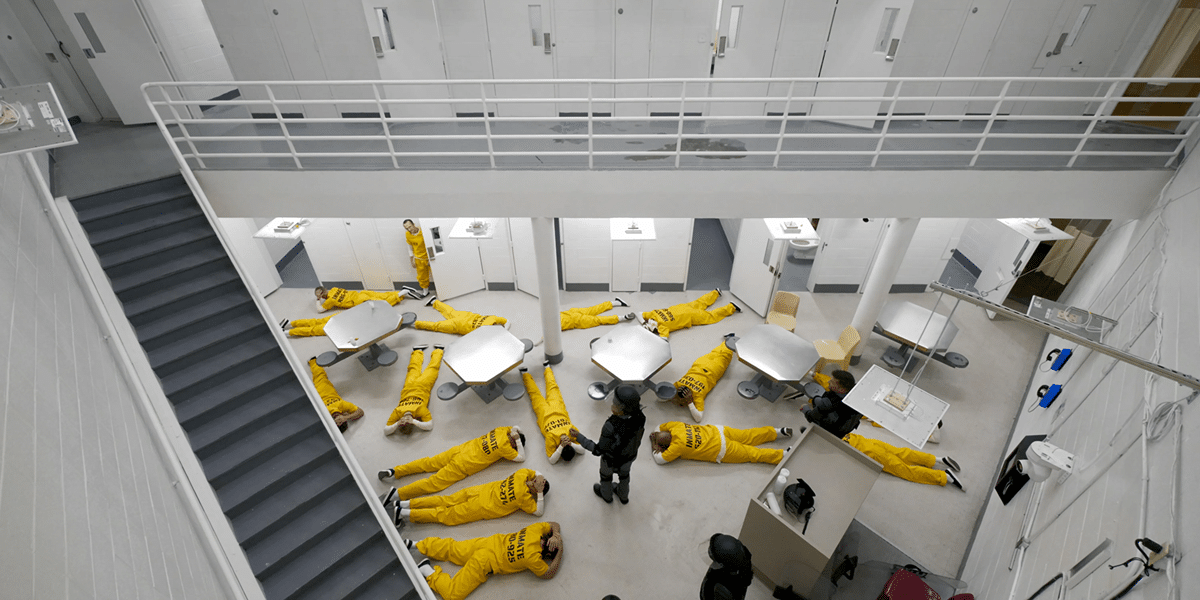
Enter Netflix’s The Stanford Prison Experiment, a six episode show that recreates Zimbardo’s experiment, albeit with a few notable tweaks: throwing an assemblage of strangers into a prison, randomly assigning them the roles of either guard or prisoner, and sitting back and waiting for the fireworks.
The original experiment
There’s reason to expect fireworks, too, given how they famously ended the original experiment. Conducted in August 1971, the original Stanford Prison Experiment was an attempt by Zimbardo to discover “the psychological effects … of becoming a prisoner or prison guard.” He recruited 24 participants and randomly assigned nine of them to be prison guards, and nine to be prisoners (the remaining six were left as standbys). Setting them up in a makeshift prison, he allowed them largely to behave as they wanted. So he said, anyway.
Six days later, Zimbardo ended up calling the whole thing off. He was, he told his fellow psychologists, horrified by the remarkably swift descent into barbarity: guards were wantonly abusing the prisoners, including making them wear bags on their heads and humiliating them.
Such findings were in line with what a different study, the Milgram Experiment, had proved only a decade earlier. In that previous study, average citizens required only the slightest bit of pressure to begin “torturing” strangers, subjecting them to electric shocks when they got quiz answers wrong (the strangers were actually acting, and no electric shocks were given). Both the Milgram Experiment and the Stanford Prison Experiment were therefore designed to prove what mass atrocities like the Holocaust had already apparently taught the world – namely, that we are all only ever one slight and sometimes random poke away from becoming monsters only too happy to torture fellow humans.
Only, it’s not quite clear that Zimbardo’s findings are as conclusive as he initially presented them. As one of the most famous psychology studies ever conducted, The Stanford Prison Experiment has been endlessly picked at, the cleanness of its data questioned: for a start, it’s not entirely true that Zimbardo and his team merely left the prisoners and guards to their own devices.
Some have argued that the guards’ barbarism was subtly encouraged by the researchers; others have noted that the researchers’ initial habit of not stepping in to correct the guards’ behaviour meant it only escalated. Both critiques of the experiment essentially make the same point: that Zimbardo’s fake prison is not the real world, and that its results are therefore not transferable.
The experiment for a new age
To its credit and my considerable surprise, the Netflix version goes some way to avoiding such critiques. When I loaded the show up, I expected the messiest possible version of Zimbardo’s work – maybe Mr Beast might swing in for the finale, I thought, in order to offer a guard a million dollars if they brutalised a prisoner.
But actually, the Netflix show initially strikes one as more comprehensive than Zimbardo’s original work. For a start, participants have been recruited across gender and racial lines – in Zimbardo’s version, they were all men, and almost exclusively white. There are also more stages to the Netflix version, with one stage abruptly swapping the roles of prisoner and guard, to see how those who have been mistreated might react when given the opportunity to mistreat. And then there’s the inclusion of a safeword, allowing participants to halt the experiment themselves, not to mention a team – rather than just Zimbardo and his colleagues – sitting on the sidelines to dissect what we’re seeing.
Initially, these additional layers impressed me. The cynical part of my brain noted that all these measures make for better TV, and were probably designed to that end, rather than to produce cleaner data – it’s hard to imagine that Netflix were motivated to greenlight a show by the desire to best a psychologist in the matter of academic rigour.
But even though I grumbled, I found myself swept along by the content, particularly when it came to the ending, which (spoiler alert) sees the prisoners form a collective mass who elect to end the experiment as one. What a balm, I thought to myself. Rather than the violent pessimism of Zimbardo’s original experiment, what the show ended up proving was the solidarity of the oppressed – not disharmony, but the power we have to unite ourselves.
Barbarism as spectacle, but make it ironic
Then I thought about it some more. And some more after that. Along the way, I found myself thinking, not for the first time recently, of the defining quality of our age – self-awareness. We’re in the era of post-post irony. Our onscreen heroes not only know they’re characters in a movie: we know that they know. Our thinking these days is inherently third-personal; we’re always considering how things might seem, and how we might interpret how they seem, and then how that interpretation itself might get interpreted by others.
In essence, we know that the base impulse to watch a restaging of an experiment where people are awful to one another is a base impulse. And the executives at Netflix definitely know a version of the Zimbardo experiment that ends positively makes more headlines than a version that ends exactly how the original one does.
What this show does, therefore, is seek to absolve you for watching depraved content by assuring you that it understands the idea of a Stanford Prison Experiment show is depraved content. It has its cake and eats it too: you get to watch all the titillating promise of people mistreating one another, and then you get the moral absolution of an ending in which the participants (almost literally) walk into the sunset. You the viewer are thus not only better than the guards – you’re better even than Zimbardo, who put them there in the first place. This time, the show says, we got it right.
But perhaps that’s around the moment where your brain reminds you that we don’t get it right out in the real world, which is not akin to either Zimbardo’s experiment, or Netflix content. Whether or not the prison system is unjust in psychological simulations might be unclear; it’s certainly clear that it’s unjust in Australia, where minorities are routinely unfairly imprisoned and killed.
There’s a lot of good reasons to be suspicious of Zimbardo’s original findings. There are even more reasons to be suspicious of the neat, calming resolution of a Netflix adaptation of those findings.
Zimbardo freaked us out by suggesting that barbarism lies always in our hearts, waiting for its moment. Netflix says: nobody really means each other harm.
In an era of unspeakable violence, both implicit and explicit, that latter conclusion – particularly when packaged and delivered by a company with a net worth of $279.1 billion USD – might be the most dangerous of them all.


BY Joseph Earp
Joseph Earp is a poet, journalist and philosophy student. He is currently undertaking his PhD at the University of Sydney, studying the work of David Hume.
Ethics in your inbox.
Get the latest inspiration, intelligence, events & more.
By signing up you agree to our privacy policy