

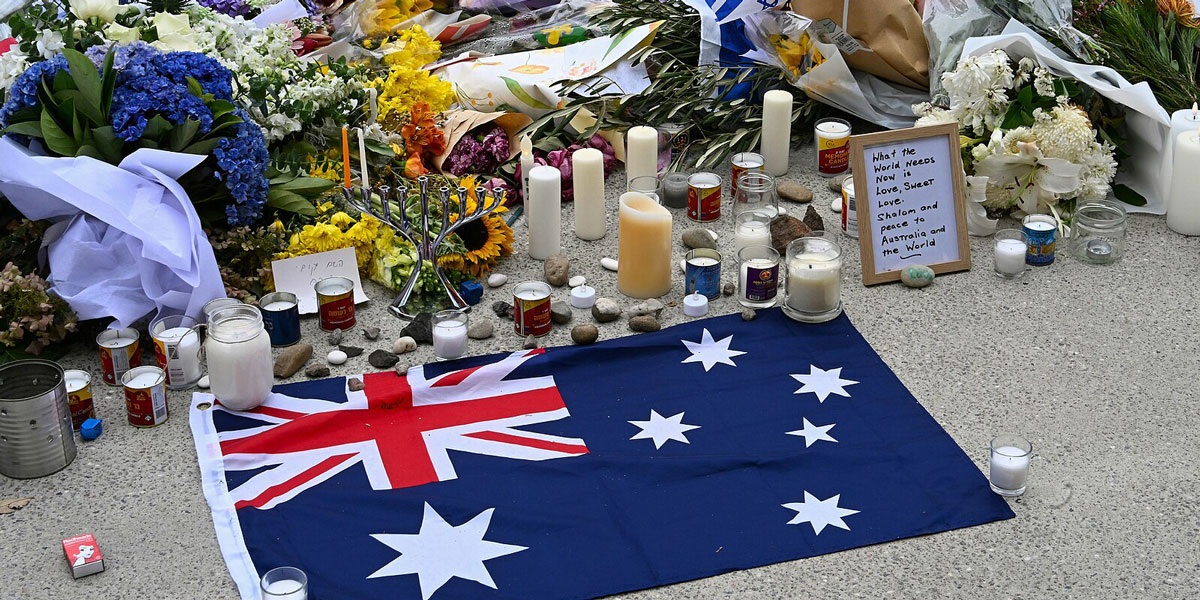
What is the best response to the massacre of Jewish people at Bondi Beach? I ask that question knowing that the best response may not be the most popular.
For example, the debate about whether or not there should be a Federal Royal Commission has made it abundantly clear that people can reasonably and sincerely disagree about what should be done. The same debate has also revealed that some people have deliberately (and others inadvertently) politicised what should be a matter of broad national consensus – with the ideal response being of a kind that meets a number of core criteria. If ever there was a time to set politics aside in favour of a singular compassion for the Jewish Community and a high regard for the national (rather than partisan) interest, then this was it.
Although united in grief and anger, the Jewish Community is not of a single mind about what should now be done. Differences of opinion are to be expected. It is wrong to expect any group of people to hold a common position simply because they share aspects of identity. Furthermore, while the Jewish Community was the explicit target of the terrorists’ attack – and bore the brunt of the carnage – they are not the only Australians to have been wounded by the murderous rampage that took place on the first night of Hanukkah. The whole nation has been scarred … and now a host of other communities are left to ask, “What caused this to happen? What can be done to prevent this in the future? Who’s next?”.
Bearing all of this in mind, I have come to the conclusion that the best possible response cannot lie in a single measure. Instead, I think the whole nation will be best served by a multi-layered approach. Importantly, such an approach would see the Commonwealth Government go well beyond where it currently stands – but in a direction that, I propose, eclipses what has been called for so far.
Each element of our national response needs to be ‘fit-for-purpose’; tailored to meet a specific need. So, what are those needs? First, the Jewish Community needs answers about what caused the Bondi Massacre – and how it might have been prevented. Second, the nation needs to know if there is anything more that could have been done by our national intelligence and security services to identify and therefore prevent the terrorists from acting. Third, we all need to understand the genesis of hate-crimes (of which antisemitism is an especially virulent, but not the only, form) in Australia – and how this might be combatted in favour of resilient bonds of social cohesion that would enable us to maintain a vibrant, multicultural society in which every person can flourish, free from fear or prejudice.
The first need will be met by the proposed NSW Royal Commission that enjoys the unfettered support of the Commonwealth Government and its departments and agencies. That support needs to be offered with the whole-hearted endorsement of the Prime Minister and unwavering direction from his Cabinet. The Commonwealth should offer binding undertakings to hold to account any of its officers, including members of past and present Commonwealth governments, who are found by the Royal Commission to have contributed to the events in Bondi – either by act or omission. Under these conditions, the proposed NSW Royal Commission will be in a position to address all of the issues arising out of the specific terrorist attack of 14 December.
The second need will be met by the Richardson Review. It will be focused and completed within a relatively short period of time. Anyone who knows or who has worked with Dennis Richardson AC knows that the inquiry will be thorough and exacting. The general public may not see all that he finds and recommends – as national-security considerations will take priority for the sake of us all. However, we can trust that nothing will be overlooked.
The third need can be answered by a National Commission of Inquiry. Unlike a Royal Commission that has a defined legal form – and often seeks to find fault and punish wrongdoers – this Commission would be required to look at the deeper causes of which the Bondi Massacre is a treacherous and violent eruption. Those causes affect multiple communities – indeed, they are a cancer eating away at the soul of Australia. The Commission should have broad powers – but it should especially be enabled to convene individuals and groups from across the nation – to hear the stories of what is happening, the impact of hatred and what can be done to prevent this from metastasising into violence.
In my opinion, we should also put the lens on multiculturalism so that rather than merely celebrating the worthy characteristics of separate communities, we learn how to strengthen the bonds between them – and commit to doing so in practice.
I know that there will be some people in the community, especially the Jewish Community, who would prefer to see the Prime Minister establish a Royal Commission to investigate the scourge of antisemitism. There is something distinctive about the hatred directed at Jews – almost unfathomable given its dark persistence over millennia. However, what I have in mind would allow the Jewish experience to be given full voice – but in conditions where we see how it relates to the experience of others in the community. In itself, that will help forge common bonds – as always happens when we see ourselves reflected in the lives of others. Given the searing nature of events, a proposed Commission should prioritise its examination of antisemitism, before all else, reporting on this within twelve months of being established.
In putting forward this proposal, I sincerely believe that nothing will be lost – and much will be gained. I hope that Prime Minister Anthony Albanese might establish a Commission that embraces the whole nation – in all of its marvellous diversity – in order to find light at this terrible moment of darkness.

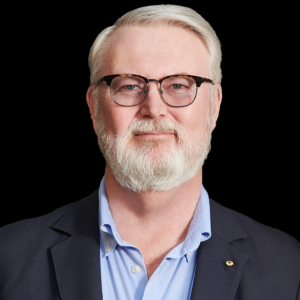
BY Simon Longstaff
Simon Longstaff began his working life on Groote Eylandt in the Northern Territory of Australia. He is proud of his kinship ties to the Anindilyakwa people. After a period studying law in Sydney and teaching in Tasmania, he pursued postgraduate studies as a Member of Magdalene College, Cambridge. In 1991, Simon commenced his work as the first Executive Director of The Ethics Centre. In 2013, he was made an officer of the Order of Australia (AO) for “distinguished service to the community through the promotion of ethical standards in governance and business, to improving corporate responsibility, and to philosophy.” Simon is an Adjunct Professor of the Australian Graduate School of Management at UNSW, a Fellow of CPA Australia, the Royal Society of NSW and the Australian Risk Policy Institute.
Ethics in your inbox.
Get the latest inspiration, intelligence, events & more.
By signing up you agree to our privacy policy