



David and Margaret spent their careers showing us exactly how to disagree
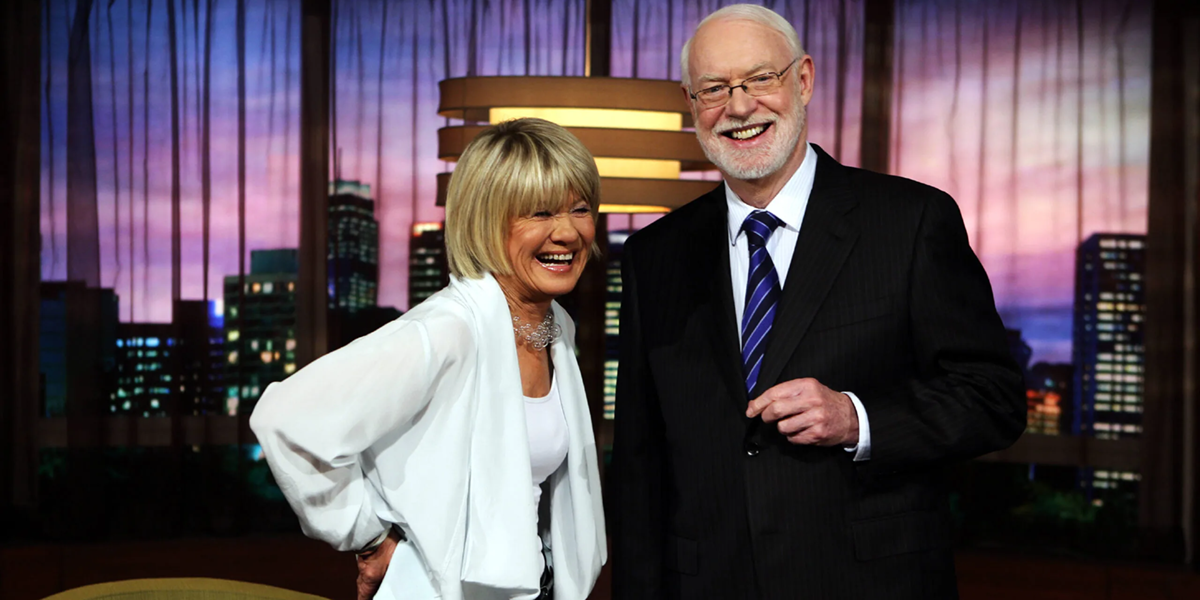
When David Stratton – critic, TV presenter and hero to a generation of movie lovers – died last week at 85, he was immediately honoured as one of this country’s true soldiers of cinema: a relentless advocate who spent his life championing the artform he loved.
Cinema had a loyal, passionate and fiercely intelligent friend in David Stratton. He was a man who worked hard to make loving movies seem serious and worthwhile – so much more than just a hobby.
But over the course of his long and varied career, Stratton didn’t just kindly, patiently and honestly explain his passions. Along with his onscreen co-host Margaret Pomeranz, he also taught us a deeply valuable ethical lesson, time and time again: a lesson in the fine art of disagreement.
What do Lars Von Trier and Vin Diesel have in common?
Pomeranz and Stratton were, from the very start of their time together, opposites. Pomeranz, who began her career in television as a producer, and was encouraged to move in front of the camera by Stratton, prized a curiously outrageous form of entertainment far more than Stratton.
Stratton loved to laugh, make no mistake, but he drew a line at anything he considered tacky. Pomeranz, by contrast, loved that stuff. When they butted heads, it was over films like Team America: World Police (Pomeranz loved it; Stratton hated it); Sex And The City 2 (Pomeranz said it contained a “jacket she’d kill for” and gave it three stars; Stratton called it “offensive”).
These differences in opinion weren’t just a casual “let’s agree to disagree” partings of ways. Once, memorably, Pomeranz gave Lars Von Trier’s Dancer in The Dark five stars, while Stratton gave it zero. When Pomeranz stood up for Vin Diesel, a performer Stratton hated, Stratton lightly poked fun at her, saying she wanted Diesel to “save her.” Possibly their biggest disagreement was over the classic Australian film Romper Stomper, starring Russell Crowe as a wild-eyed neo-Nazi. Stratton not only thought the film was terrible, he thought it was actively ethically harmful. Pomeranz gave it five stars.
Sometimes these disagreements got a little heated. Stratton could be dismissive; Pomeranz seemed occasionally exasperated with him. But the pair never lost respect for one another, no matter how far apart their tastes pulled them – and, importantly, they never started throwing barbs at each other. Their disagreement was localised to the thing they were disagreeing about, not ad hominem snipes at the other’s character.
Pomeranz herself acknowledged this, in a recent tribute written to honour her friend and colleague. “I think it’s extraordinary that, over all the time that David and I worked together, we never had a falling out”, she wrote. Disagreements between the two were common. But true breaks in the relationship – true threats to their working together – never were.
The power of disagreement
Sometimes, disagreement is cast as an impediment to societal functioning. We can all be guilty of occasionally speaking as though disagreement is the enemy – as though for us to all flourish, we should all get along, all the time. That’s not to say that there are some matters where disagreement should be encouraged – the power of disagreement is not a free card to put every matter up for debate, no matter how harmful.
But the history of philosophy shows us there’s power in sometimes parting opinion. Plato, for instance, presented almost all of his arguments in the form of debates, with characters going back and forth amongst each other on what is the correct behaviour. Plato’s “dialogues”, and thus, his entire ethical worldview, were fashioned out of disagreement.
It is in disagreement, after all, that we get to honour one of the beautiful things about our world – difference, uniqueness, and the full richness of human experience.
It would be a very boring, and perhaps even insidious, world if we all thought the same thing. After all, a forced unity of opinion is one of the hallmarks of fascism.
Disagreements, if handled and conducted well, can also guide us away from extremes. In some matters, truth lies in the middle of two poles. So it went on The Movie Show at least – I am not convinced we always agreed with our favourite from the pair. As viewers, our own tastes fluctuated between the extremes of Pomeranz and Stratton. In their disagreements, we could pick and choose elements of their tastes, and construct our own.
And again, these were debates that never descended into name-calling, or anger. In this, Pomeranz and Stratton taught us another ethical lesson – that we can treat someone disagreeing with us as someone offering us kindness. Having to justify and argue for our own positions helps us better understand them. And it helps us better understand the world around us; the people around us.
Laying my own cards on the table, I’ve always been more of a Pomeranz person (I love Von Trier, Romper Stomper, and Team America). But that’s just the thing. No matter how much I, a viewer raised on The Movie Show, found myself grumpily disagreeing with Stratton, it never made me dislike him. And when he passed, the loss I felt was not just the loss of a man I had always admired. It was the loss of a defender of art and a good sparring partner – no matter that it was one-sided sparring, through the TV. Disagreement done well is a gift. And no one more generously gave out that gift than David Stratton.


BY Joseph Earp
Joseph Earp is a poet, journalist and philosophy student. He is currently undertaking his PhD at the University of Sydney, studying the work of David Hume.
Ethics in your inbox.
Get the latest inspiration, intelligence, events & more.
By signing up you agree to our privacy policy






That’s not me: How deepfakes threaten our autonomy

In early 2025, 60 female students from a Melbourne high school had fake, sexually explicit images of themselves shared around their school and community.
Less than a year prior, a teenage boy from another Melbourne high school created and spread fake nude photos of 50 female students and was let off with only a warning.
These fake photos are also known as deepfakes, a type of AI-augmented photo, video or audio that fabricates someone’s image. The harmful uses of this kind of technology are countless as the technology becomes more accessible and more convincing: porn without consent, financial loss through identity fraud, the harm to a political campaign or even democracy through political manipulation.
While these are significant harms, they also already exist without the aid of deepfakes. Deepfakes add something specific to the mix, something that isn’t necessarily being accounted for both in the reaction to and prevention of harm. This technology threatens our sense of autonomy and identity on a scale that’s difficult to match.
An existential threat
Autonomy is our ability to think and act authentically and in our best interests. Imagine a girl growing up with friends and family. As she gets older, she starts to wonder if she’s attracted to women as well as men, but she’s grown up in a very conservative family and around generally conservative people who aren’t approving of same-sex relations. The opinions of her family and friends have always surrounded her, so she’s developed conflicting beliefs and feelings, and her social environment is one where it’s difficult to find anyone to talk to about that conflict.
Many would say that in this situation, the girl’s autonomy is severely diminished because of her upbringing and social environment. She may have the freedom of choice, but her psychology has been shaped by so many external forces that it’s difficult to say she has a comprehensive ability to self-govern in a way that looks after her self-interests.
Deepfakes have the capacity to threaten our autonomy in a more direct way. They can discredit our own perceptions and experiences, making us question our memory and reality. If you’re confronted with a very convincing video of yourself doing something, it can be pretty hard to convince people it never happened – videos are often seen as undeniable evidence. And more frighteningly, it might be hard to convince yourself; maybe you just forgot…
Deepfakes make us fear losing control of who we are, how we’re perceived, what we’re understood to have said, done or felt.
Like a dog seeing itself in the mirror, we are not psychologically equipped to deal with them.
This is especially true when the deepfakes are pornographic, as is the case for the vast majority of deepfakes posted to the internet. Victims of these types of deepfakes are almost exclusively women and many have commented on the depth of the wrongness that’s felt when they’re confronted with these scenes:
“You feel so violated…I was sexually assaulted as a child, and it was the same feeling. Like, where you feel guilty, you feel dirty, you feel like, ‘what just happened?’ And it’s bizarre that it makes that resurface. I genuinely didn’t realise it would.”
Think of the way it feels to be misunderstood, to have your words or actions be completely misinterpreted, maybe having the exact opposite effect you intended. Now multiply that feeling by the possibility that the words and actions were never even your own, and yet are being comprehended as yours by everyone else. That is the helplessness that comes with losing our autonomy.
The courage to change the narrative
Legislation is often seen as the goal for major social issues, a goal that some relationships and sex education experts see as a major problem. The government is a slow beast. It was only in 2024 that the first ban on non-consensual visual deepfakes was enacted, and only in 2025 that this ban was extended to the creation, sharing or threatening of any sexually explicit deepfake material.
Advocates like Grace Tame have argued that outlawing the sharing of deepfake pornography isn’t enough: we need to outlaw the tools that create it. But these legal battles are complicated and slow. We need parallel education-focused campaigns to support the legal components.
One of the major underlying problems is a lack of respectful relationships and consent education. Almost 1 in 10 young people don’t think that deepfakes are harmful because they aren’t real and don’t cause physical harm. Perspective-taking skills are sorely needed. The ability to empathise, to fully put yourself in someone else’s shoes and make decisions based on respect for someone’s autonomy is the only thing that can stamp out the prevalence of disrespect and abuse.
On an individual level, making a change means speaking with our friends and family, people we trust or who trust us, about the negative effects of this technology to prevent misuse. That doesn’t mean a lecture, it means being genuinely curious about how the people you know use AI. And it means talking about why things are wrong.
We desperately need a culture, education and community change that puts empathy first. We need a social order that doesn’t just encourage but demands perspective taking, to undergird the slow reform of law. It can’t just be left to advocates to fight against the tide of unregulated technological abuse – we should all find the moral courage to play our role in shifting the dial.

BY Daniel Finlay
Daniel is a philosopher, writer and editor. He works at The Ethics Centre as Youth Engagement Coordinator, supporting and developing the futures of young Australians through exposure to ethics.
Ethics in your inbox.
Get the latest inspiration, intelligence, events & more.
By signing up you agree to our privacy policy