


The question AI can't answer for us

Introducing Ethical by Design: Good Technology Principles for AI
There’s a particular kind of vertigo that comes from watching a technology reshape the world faster than our frameworks can keep up. We’ve been here before with the internet, social media, and the smartphone. Each time, the ethical reckoning arrived late, if it ever came at all. Foreseeable and preventable harms accumulated while the builders moved fast, and the rest of us were left to sort through the wreckage.
With the proliferation of artificial intelligence, we don’t have the luxury of retrospect. Systems are already making decisions about who gets a loan, who gets flagged at a border, whose résumé clears the first filter. The question of what AI should do, not just what it can do, is no longer theoretical. It’s operational and it’s urgent.
This is the moment that Ethical by Design: Good Technology Principles for AI is written for.
Building on what endures
The Ethics Centre has been asking hard questions about technology and human flourishing for a long time. When we published the original Ethical by Design principles in 2018, AI was largely a specialist concern: something debated in research labs and tech conferences, not yet woven into the fabric of daily life. Those principles – that technology must respect human dignity, anticipate harm, and serve a genuine purpose – were designed to be durable. And they are: the ethical foundations haven’t shifted.
But the landscape has.
Generative AI didn’t just accelerate existing trends; it introduced a qualitatively different kind of challenge. Systems that learn, adapt, and produce outputs their own designers do not intend and cannot fully explain don’t fit neatly into frameworks built for more legible technologies. When a model generates a deepfake, hallucinates a legal precedent, or encodes a historical bias into a hiring recommendation, the question of accountability doesn’t resolve cleanly. The complexity is real, and it demands a response equal to it.
This updated framework extends the original Ethical by Design principles. What’s new is the application. The framework intentionally grapples seriously with dimensions of AI ethics that are newer to mainstream conversation: the environmental cost of training and deploying models at scale; the hidden labour of the data annotators and content moderators whose work makes AI possible; the specific risks of synthetic content in an information environment already struggling with trust. These aren’t edge cases. They’re central to what it means to build AI responsibly.
For the people who build and lead
If you’re making decisions about whether and how to deploy AI in your organisation, this framework is for you. Not as a compliance checklist, but as a set of principles rigorous enough to stress-test your own reasoning. The central question of this framework is deceptively simple: ought before can.
Before we ask whether an AI system is technically feasible or commercially viable, we ask whether it should exist: whether its purpose is legitimate, its means are ethical, and its costs are fairly distributed.
That question doesn’t have a technical answer. No model can generate it for you. It requires the kind of careful, honest ethical reasoning that The Ethics Centre exists to support. This framework is designed to make that more accessible.
Commercial pressures and competitive dyanmics are real. The expectation that organisations will adopt AI quickly, confidently, and at scale is entirely real. None of that changes the ethical calculus. It just makes the discipline harder and more necessary.
What we’ve tried to do here is give you something useful for that harder work: eight principles with philosophical grounding and concrete practices, applied to the specific terrain of AI systems. Principles that don’t pretend the choices are easy, but insist that they are choices that can and should be made with explicit intention and accountability for impact.
The revolution is already here. The question is what we choose to build with it, and who we choose to protect in the process.
Download a copy of Ethical by Design: Good Technology Principles for AI here.
If you’d like to discuss implementing ethical AI in your organisation, contact consulting@ethics.org.au.


BY The Ethics Centre
The Ethics Centre is a not-for-profit organisation developing innovative programs, services and experiences, designed to bring ethics to the centre of professional and personal life.
Ethics in your inbox.
Get the latest inspiration, intelligence, events & more.
By signing up you agree to our privacy policy




Welcome to Country comes from a place of deep, sincere respect
It was just a few days after my seventeenth birthday that I arrived on Groote Eylandt, in the Gulf of Carpentaria, for the first time.
I had left school without any savings and needed to earn enough income to support myself when eventually (I hoped) I would attend university. But for the time being, in early in 1976, I would be working as a ‘Service Attendant’ (a cleaner and ‘dog’s body’) in one of the most remote communities in Australia.
That was the beginning of an extraordinary set of experiences – some of the most memorable of my life – which included being adopted into the kinship structure of the Anindilyakwa people. My connection to the Lalara Clan remains active and has been preserved for five decades.
From time-to-time, I would be invited to travel to the south of the main island, to visit the community of Yenbakwa. This was located within the lands of the Amagula Clan and had been resettled by the community under the leadership of the formidable Nanjiwarra Amagula. A major cultural and political figure, Nanjiwarra had become disillusioned with life within the Anglican mission established as Angurugu. Instead, he thought his clan would flourish if it returned to its homelands to live a traditional life that had been refined over thousands of years. And, indeed, the Yenbakwa I visited was a kind of ‘paradise on earth’. It was highly organised and functional. Life was simple. But the environment was clean and scrupulously cared for by people well-fed from the remarkable bounty offered by what was at hand in land and sea.
Travelling to Yenbakwa always followed a protocol. It was not that one simply headed down to arrive unannounced. This protocol applied to Indigenous and non-Indigenous alike. A key moment was when you arrived at the boundary of the Amagula lands. All clan lands are clearly delineated. The boundaries are well known. You do not cross into another person’s Country without permission. So, we would always meet with a group of Amagula warriors at a pre-arranged time and place. There we would be welcomed before being escorted further into the Amagula lands and down to Yenbakwa. On arrival, we would be allocated a tree where we were to camp. Typically, some of the women would help set up the site while we would join the men and go hunting … or perform some other appropriate task. This sense of ‘respecting boundaries’ extended into the night. Families would typically gather around a fire near a tree that was their ‘base’ (my inadequate description not theirs). Again, protocol prescribed that you would approach no further than the edge of the firelight. There you would wait to be recognised and then, perhaps, invited into the gathering.
I mention all of this because when I first encountered a ‘Welcome to Country’ it was, for me, the most normal thing in the world. It was not a ‘made up’ convention. It was a simple expression of a traditional practice that I had personally experienced ‘for real’ back on Groote Eylandt in the 1970s. So, I am perplexed by the criticism of a custom that is intended to be a symbol of unity and our collective belonging to ‘Country’. Indeed, I think that the source of opposition arises out a significant misunderstanding of what lies at the heart of a ‘Welcome to’ or ‘Acknowledgement of’ Country.
An immediate clue lies in the words spoken at such times. Perhaps it slips by unnoticed; however, when addressing ‘Country’ the first thing to be mentioned is people. Not places, not geographic features … but people. So, people in the Sydney CBD will speak of the Gadigal people – one of the clans that make up the Eora nation. This is because at least in the areas I know best (Groote Eylandt) there is no distinction between ‘people’ and ‘Country’.
From this perspective, we do not live ‘on’ Country. We are ‘of’ Country – related to all that is … seen and unseen … in an unbroken chain of being.
Perhaps most important of all is that this belonging extends to everybody living within the boundaries of ‘Country’. A person equally belongs irrespective of gender, religion, culture, genetics … or any other marker of difference. That is, Indigenous people do not claim to belong any more or less than anyone else.
Where the difference lies is in who has authority to ‘speak for Country’. Again, I will only speak for what I know. On Groote, ‘authority’ is divided between those who speak for a clan’s Country as a whole and those (from a different clan) who are responsible for the sacred sites within another person’s country. It is a complex, balanced system that has been developed over millennia – and it works. The responsibility to ‘speak’ for Country and to ensure it is well-cared for extends to caring for any person who enters into that Country. New arrivals become part of it all – and need to be looked after. So, in some traditional rituals of welcoming, people would be smoked or touched with the sweat of local people so that they carry the local scent. At other times and places, the ancestors will be called out to; letting them know who is about (ancestors have an ongoing presence). Finally, the right to ‘speak for Country’ is not automatically conferred. One has to earn the right – no matter who you are. That is why for many Indigenous Australians education in culture is both compulsory and life-long.
Taken as a whole, I think that, wherever possible, one should look to local First Nations people, who have earned the right to ‘speak for Country’, to undertake the ‘Welcome’. It is also why we acknowledge Country by paying respect to those who have cared for Country over thousands of generations. We do so in the same way that we respect any group of people who have devoted themselves to the common good.
We should do so knowing that this is not to confer a distinction on people who are different to us – but to acknowledge the fundamental equality of our belonging.
Given the remarkable diversity of modern Australia – with people living here from every part of the world; with a swirling mixture of languages, cultures, and religions there is one indisputable thing that we all share in common. It is that we all live on Country that has been cared for, forever. I can think of nothing more unifying than being welcomed into, and in turn acknowledging Country – as was done when I first visited Yenbakwa half a century ago.
This article is an edited version that was originally published in The Australian.
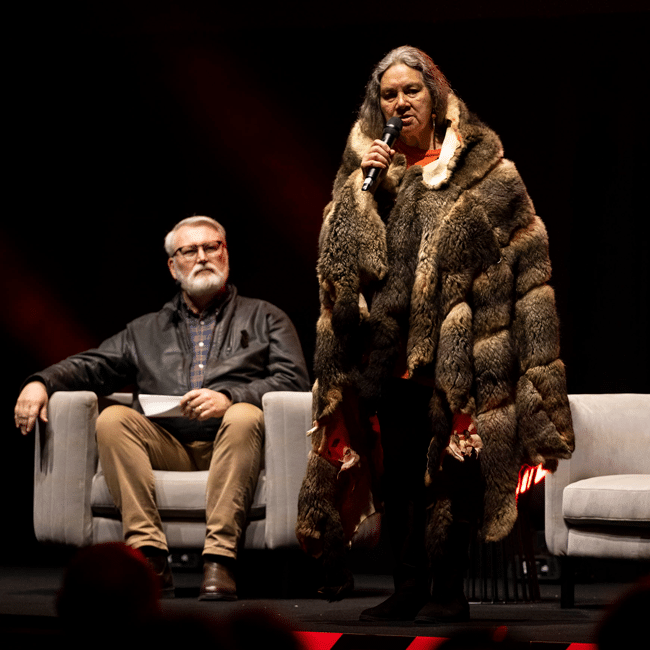
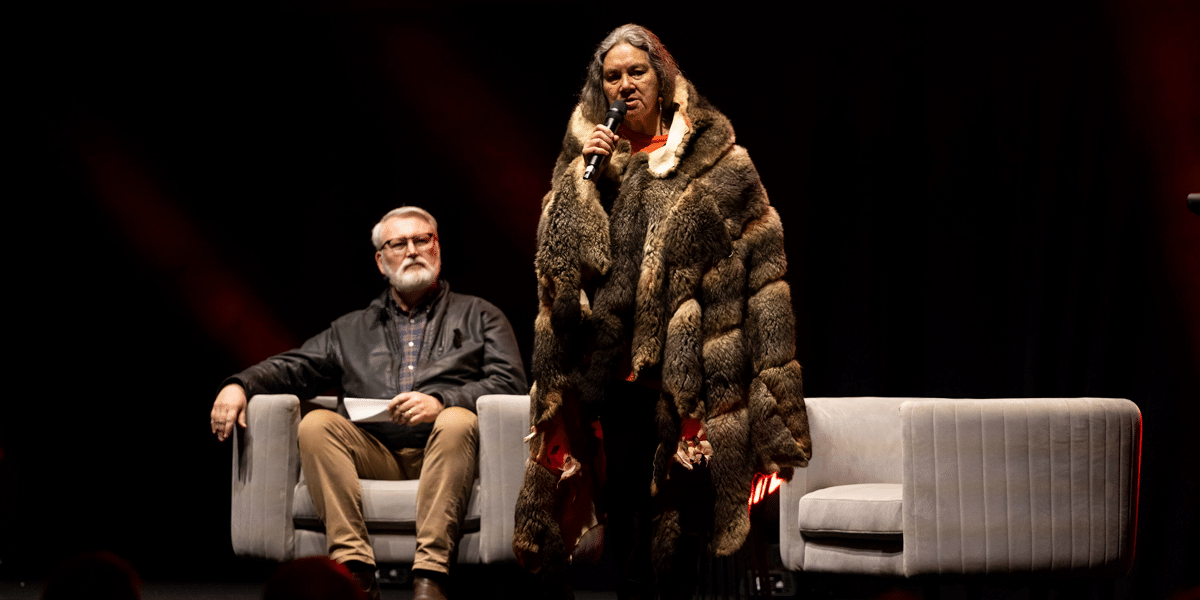
Image: Aunty Rhonda Dixon presents Welcome to Country at Festival of Dangerous Ideas 2022, photo by Ken Leanfore
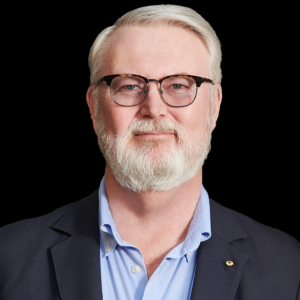
BY Simon Longstaff
Simon Longstaff began his working life on Groote Eylandt in the Northern Territory of Australia. He is proud of his kinship ties to the Anindilyakwa people. After a period studying law in Sydney and teaching in Tasmania, he pursued postgraduate studies as a Member of Magdalene College, Cambridge. In 1991, Simon commenced his work as the first Executive Director of The Ethics Centre. In 2013, he was made an officer of the Order of Australia (AO) for “distinguished service to the community through the promotion of ethical standards in governance and business, to improving corporate responsibility, and to philosophy.” Simon is an Adjunct Professor of the Australian Graduate School of Management at UNSW, a Fellow of CPA Australia, the Royal Society of NSW and the Australian Risk Policy Institute.
Ethics in your inbox.
Get the latest inspiration, intelligence, events & more.
By signing up you agree to our privacy policy