



The rise of Artificial Intelligence and its impact on our future
It’s all fun and games until robots actually take over our jobs. AI is in our future and is fast approaching. Simon Longstaff considers how we make that tomorrow good.
Way back in 1950, the great computer scientist, Alan Turing, published in Mind a paper that set a test for determining whether or not a machine possesses ‘artificial intelligence’.
In essence, the Turing Test is passed if a human communicating with others by text cannot tell the difference between a human response and one produced by the machine. The important thing to note about Turing’s test is that he does not try to prove whether or not machines can ‘think’ as humans do – just whether or not they can successfully imitate the outcomes of human thinking.
Although the makers of a chat-bot called Eugene Goostman claimed it passed the test (by masquerading as a 13 year old boy) general opinion is the bot was designed to ‘game’ the system by using the boy’s apparent young age as a plausible excuse for the mistakes it made in the course of the test. Even so, the development of computers continues apace – with ‘expert systems’ and robots predicted to displace humans in a variety of occupations ranging from the legal profession to taxi drivers and miners.
All of this is causing considerable anxiety – not unlike that felt by people whose lives were upended by the development of steam power and mass production during the first Industrial Revolution. Back then people could more or less understand what was going on. The machines (and how they worked) were fairly obvious.
These days the inner workings of our advanced machines are far more mysterious. Coal or timber burning in a furnace is tactile and observable. But what exactly is an electron? How do you see it? And a Q-bit?
Add to this the extraordinary power of modern machines and it is not surprising that some people (including the likes of Stephen Hawking) are expressing caution about the potential threat our own technologies present, not only to our lifestyles, but to human existence. Of course, not everybody is so pessimistic.
However, the key thing to note here is we have choices to make about how we develop our technology. The future is not inevitable – we make it. And that is where ethics comes in.
This is one small example of how our choices matter. At first glance, let’s imagine how wonderful it would be if we could build batteries that never need recharging. That might seem to solve a raft of problems.
However, as Raja Jurdak and Brano Kusy observe in The Conversation, there may be ‘downsides’ to consider, “creating indefinitely powered devices that can sense, think, and act moves us closer to creating artificial life forms.
Couple that with an ability to reproduce through 3D printing, for example, and to learn their own program code, and you get most of the essential components for creating a self-sustaining species of machines.” Dystopian images of the Terminator come to mind.
However, back to Turing and his test. As noted above, computers that pass his test will not necessarily be thinking. Instead, they will be imitating what it means to be a thinking human being. This may be a crucial difference.
What will we make of a medi-bot that tells us we have cancer and tries to comfort us – but that we know can have no authentic sense of its (or our) mortality? No matter how good it is at imitating sympathy, won’t the machine’s lack of genuine understanding and compassion lead us to discount the worth of its ‘support’?
Then there is the fundamental problem at the heart of the ethical life lived by human beings. Our form of being is endowed with the capacity to make conscious, ethical choices in conditions of fundamental uncertainty. It is our lot to be faced with genuine ethical dilemmas in which there is, in principle, no ‘right’ answer.
This is because values like truth and compassion can be held with equal ‘weight’ and yet pull us in opposite directions. As humans we know what it means to make a responsible decision – even in the face of such radical uncertainty. And we do it all the time.
What will a machine do when there is no right answer? Will it do the equivalent to flipping a coin? Will it be indifferent to the answer it gets and act on the results of chance alone? Will that ever be good enough for us and the world we inhabit?
Ethics in your inbox.
Get the latest inspiration, intelligence, events & more.
By signing up you agree to our privacy policy




BY Simon Longstaff
Simon Longstaff began his working life on Groote Eylandt in the Northern Territory of Australia. He is proud of his kinship ties to the Anindilyakwa people. After a period studying law in Sydney and teaching in Tasmania, he pursued postgraduate studies as a Member of Magdalene College, Cambridge. In 1991, Simon commenced his work as the first Executive Director of The Ethics Centre. In 2013, he was made an officer of the Order of Australia (AO) for “distinguished service to the community through the promotion of ethical standards in governance and business, to improving corporate responsibility, and to philosophy.” Simon is an Adjunct Professor of the Australian Graduate School of Management at UNSW, a Fellow of CPA Australia, the Royal Society of NSW and the Australian Risk Policy Institute.

BY The Ethics Centre
The Ethics Centre is a not-for-profit organisation developing innovative programs, services and experiences, designed to bring ethics to the centre of professional and personal life.


Doing good for the right reasons: AMP Capital's ethical foundations
Discover the ethical processes behind AMP Capital’s tobacco divestment. There are three years of thinking behind those headlines, explains Simon Longstaff. He was there to help them through.
You may have seen that AMP Capital decided to divest from tobacco and munitions. The organisation will sell A$440 million of tobacco investments and a further A$130 million in cluster munitions and landmines.
Although this is big news, it isn’t the first time a divestment like this has happened in Australia. What makes this news more significant is AMP Capital’s decision hasn’t come from traditional divestment strategies like shareholder activism or social protest. Instead, it is the product of a much larger process of ethical reflection.
This reflection started three years ago, when AMP Capital approached me, wanting to set its entire investment portfolio on a solid ethical foundation. Together, we sought to discover what that foundation might be.
What we learned surprised us. At first, we thought ‘fiduciary duty’ would be the main issue – AMP Capital’s duty to act in the best interests of its investors. AMP Capital is totally committed to discharging this obligation.
However, it turns out that there was another equally important issue – one that is for the most part ignored.
It concerns AMP Capital itself. Is it driven entirely by the ethics of others, washing its hands of all ethical responsibility? Or does AMP Capital have a right to set the ethical boundaries within which it offers its goods and services in the expectation of reward?
We concluded that just as a person can decide not to do something that goes against their conscience, so can a business.
Once we’d agreed on this basic idea, AMP Capital was able to build an ethical investment foundation based on a few core principles that we believed to be self-evident and so firmly grounded as to be uncontroversial. They are:
- No investment may be made if it leads to or supports conduct that violates the principle of ‘respect for persons’. AMP Capital will not invest in entities or activities that undermine fundamental human dignity, like those that treat people merely as a tool for some other end.
- AMP Capital will not enable – or seek to profit from – activities that violate international human rights law.
- AMP Capital will actively consider the extent to which its investments are in entities or products that cause harm. The relevant test is this – to what extent (if any) can this product be used without causing harm to the user or others?
- In assessing harm, AMP Capital will seek to determine the extent any harm is an inescapable side-effect of doing something good. If harm is inescapable, are the adverse side-effects mitigated to the greatest extent possible?
- AMP Capital will have regard to issues of ‘materiality’ – are the ethically problematic issues central to the investment being considered? AMP Capital will also bear in mind whether engagement with a company might be a better route to achieving a positive ethical outcome.
- AMP Capital will be open to being corrected if they’re mistaken about any of the facts or assumptions that have a bearing on deciding if a company’s conduct or products are harmful.
This framework can be applied to any situation. Regardless of the product or moment, it gives a strong ethical foundation for all the choices the company might make in the future.
Good foundations are something that every company needs. If embedded and practiced, they can reassure employees and customers that business choices are based on ethical reflection rather than the pressure of public opinion or the pursuit of profits at all cost. And they bring consistency and confidence to ethical decisions.
I’m very proud to have worked with AMP Capital on developing this framework. I hope it helps them and inspires others to do the same.




BY Simon Longstaff
Simon Longstaff began his working life on Groote Eylandt in the Northern Territory of Australia. He is proud of his kinship ties to the Anindilyakwa people. After a period studying law in Sydney and teaching in Tasmania, he pursued postgraduate studies as a Member of Magdalene College, Cambridge. In 1991, Simon commenced his work as the first Executive Director of The Ethics Centre. In 2013, he was made an officer of the Order of Australia (AO) for “distinguished service to the community through the promotion of ethical standards in governance and business, to improving corporate responsibility, and to philosophy.” Simon is an Adjunct Professor of the Australian Graduate School of Management at UNSW, a Fellow of CPA Australia, the Royal Society of NSW and the Australian Risk Policy Institute.

BY ethics


Between frenzy and despair: navigating our new political era

In years past, one of my roles was to take meteorological readings for the north-west sector of the Gulf of Carpentaria. My job was to relay weather readings to an operator in Katherine.
From there they would be added to the data pool used by the Bureau of Meteorology to track and predict Australia’s weather. Although my part was very basic, it was essential. And so it was that I found myself reading the weather at the height of a tropical cyclone.
I stepped into the maelstrom, physically wrestling the wind and exhilarated by this personal encounter with the unbridled power of nature. Meanwhile, other (perhaps more sensible) people were gathered together in shelters. The same cyclone that made me feel alive left them terrified. One phenomenon, two very different responses.
Whatever divides Trump’s supporters from his critics, they are united by one thing – both groups are being buffeted by powerful winds of change.
For me, that cyclone is like President Trump’s emerging impact on the world. The flurry of claims and counter-claims, fake news, alternative facts and the swirling vortex of presidential orders demonstrate enormous power and have provoked diverse responses.
For some people, President Trump is a thrilling departure from ‘politics as normal’. For others, his conduct is a frightening repudiation of all they believe in. Whatever divides Trump’s supporters from his critics, they are united by one thing – both groups are being buffeted by powerful winds of change. As such, they have a common need to find stable anchor points.
Trump supporters risk being swept away on a tide of populism that knows no boundaries and ultimately eats its own. Critics risk their scepticism giving way to outright cynicism, the kind that inevitably corrodes the bonds of human society. Of the two risks, the latter is the greater. Cynicism often ends in resignation and the hopelessness of despair. Citizens disengage and democracies unravel from within.
Neither outcome – self-defeating populism or rampant despair – is inevitable.
History is full of examples of individuals and societies who have lost their ethical bearings, only later to look back in horror at what has been done.
Core values and principles provide the anchor points needed to hold people steady. They are the ground we return to whenever making conscious decisions about how to live as individuals and as a society. Although the specifics may vary between people, places and times, the basic structure is the same. With one important exception, every human being makes choices informed by their values and principles.
The exception is the problem.
Too often, people act without giving much thought to what they are doing. Instead, habits provide the pattern for accepted behaviour. In these circumstances it is all too easy for good people to drift until they either act badly or become complicit in the bad deeds of others. History is full of examples of individuals and societies who have lost their ethical bearings, only later to look back in horror at what has been done.
An ethical life is a life for the hopeful.
In nearly every case, the majority has made no active choice to take the wrong path. Instead, they have been led there in ignorance by a demagogue or have gone along unwillingly, having lost their capacity to resist to the pits of despair.
At its heart, ethics is about living an ‘examined life’. It is about resisting the temptation to act out of habit alone – even if those habits are virtuous. Although we inherit values and principles from our parents and other people important in our lives, a mature person becomes capable of making these values and principles their own. Their lives will be more than a mere imitation of others. It is only by moving beyond inherited values and moral codes that we can genuinely take responsibility for our own lives.
From a practical point of view, the first step is to establish a conscious, personal inventory of values and principles. You do this by asking “what things are good at their core and worth choosing above other things?” and “what are the right ways to obtain those things?”
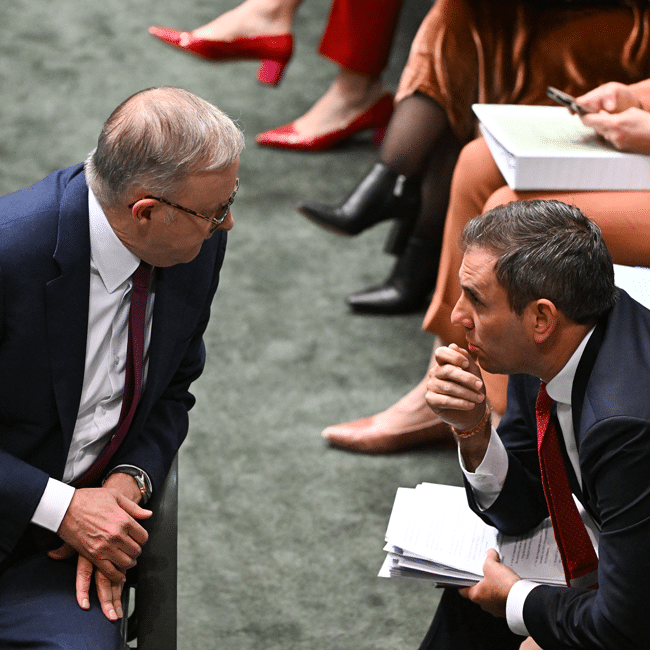
An ethical life is a life for the hopeful, a way of living that strengthens the sinews of all those affected by the political project embodied by President Trump. Political bluster can be every bit as dangerous as cyclonic winds. Let’s strengthen the ground on which we meet it.
Ethics in your inbox.
Get the latest inspiration, intelligence, events & more.
By signing up you agree to our privacy policy



BY Simon Longstaff
Simon Longstaff began his working life on Groote Eylandt in the Northern Territory of Australia. He is proud of his kinship ties to the Anindilyakwa people. After a period studying law in Sydney and teaching in Tasmania, he pursued postgraduate studies as a Member of Magdalene College, Cambridge. In 1991, Simon commenced his work as the first Executive Director of The Ethics Centre. In 2013, he was made an officer of the Order of Australia (AO) for “distinguished service to the community through the promotion of ethical standards in governance and business, to improving corporate responsibility, and to philosophy.” Simon is an Adjunct Professor of the Australian Graduate School of Management at UNSW, a Fellow of CPA Australia, the Royal Society of NSW and the Australian Risk Policy Institute.
BY The Ethics Centre
The Ethics Centre is a not-for-profit organisation developing innovative programs, services and experiences, designed to bring ethics to the centre of professional and personal life.
You are more than your job

There are many ways we define our personal identity. Often, we define it by the roles we play in life.
We might think of ourselves as a child, parent, sibling, spouse, lover, friend… It is remarkable how we integrate all these different roles and relationships into our own, singular person.
People may often identify themselves according to their work. It’s been happening throughout history, as we can hear in occupational surnames such as Carpenter, Carter, Baker and Wheeler. We even link our identity with what we do for bureaucratic reasons. For example, every traveller is required to state their occupation when departing from or arriving in Australia.
Personal value has shifted focus from our character, personality, and relationships, to our role or place in society. It is no longer a question of who we are but what we do.
Casual conversations, too, eventually veer towards the question, “what do you do?” But a few years ago, I noticed the response to the question “How are you?” was changing from “I’m well” to “I’m busy”. I wondered what lay behind this altered response. What were they trying to say?
I concluded that the words “I am busy” are a proxy for “I am valued/needed”. My worth is affirmed by the fact I am in demand to the point of being busy.
If I’m correct, this marks a subtle but important change. Personal value has problematically shifted focus from our character, personality and relationships to our role or place in society. It is no longer a question of who we are but what we do.
Perhaps we should reflect on some of the deeper questions to do with identity, meaning and value.
For the most part, we might not notice this change in emphasis. However, if what I suspect is true, a holiday such as the enforced Christmas vacation could be a period of stress and dislocation for people who define themselves by their work – especially if they live alone and are without family or friends.
For some people, a job is not only a source of identity, it may also be their principal social environment, providing a regular opportunity for human contact. For such people, being deprived of this context can be a profound loss. To be ‘on leave’ is to be cut off from their principal source of identity.
Those of us with established social networks could help by reaching out to such people and making sure they’re included in holiday celebrations. Among other things, this sends a signal that the person is valued for more than their work.
Work-focused individuals could also volunteer with charities during the holiday season. This would provide a readymade social context and a valuable, alternative source of meaning and identity.
However, especially at Christmas time, perhaps we should reflect on some of the deeper questions dealing with identity, meaning and value. At the heart of ethics is a belief in the intrinsic worth of every person – irrespective of their gender, race, religion, sexuality… or job.
Ethics in your inbox.
Get the latest inspiration, intelligence, events & more.
By signing up you agree to our privacy policy


BY Simon Longstaff
Simon Longstaff began his working life on Groote Eylandt in the Northern Territory of Australia. He is proud of his kinship ties to the Anindilyakwa people. After a period studying law in Sydney and teaching in Tasmania, he pursued postgraduate studies as a Member of Magdalene College, Cambridge. In 1991, Simon commenced his work as the first Executive Director of The Ethics Centre. In 2013, he was made an officer of the Order of Australia (AO) for “distinguished service to the community through the promotion of ethical standards in governance and business, to improving corporate responsibility, and to philosophy.” Simon is an Adjunct Professor of the Australian Graduate School of Management at UNSW, a Fellow of CPA Australia, the Royal Society of NSW and the Australian Risk Policy Institute.
BY The Ethics Centre
The Ethics Centre is a not-for-profit organisation developing innovative programs, services and experiences, designed to bring ethics to the centre of professional and personal life.

Why hard conversations matter

There are times in the history of a nation when its character is tested and defined. Too often it happens with war, natural disasters or economic collapse. Then the shouting gets our attention.
But there are also our quieter moments – the ones that reveal solid truths about who we are and what we stand for.
How should we recognise Indigenous Australians? Can our economy be repaired in a manner that is even-handed? How will we choose if forced to decide between China and the United States? How do we create safe ways for people seeking asylum? Can we grow our economy and protect our people and environments? These are just some of the questions we face.
Too often, I see conversations shut down before they have even begun. People with a contrary point of view are faced with outrage, shouted down or silenced by others driven by the certainty of righteous indignation.
And here’s another question. Do we have the capacity to talk about these things without tearing ourselves and each other apart?
There are some safe places for open conversation about difficult questions. Thirty years ago I began work at a not-for-profit, The Ethics Centre dedicated to creating them. The Festival of Dangerous Ideas now enters its 11th year with a new digital format to cater to our current times, bringing leading thinkers from around the world together to discuss important issues.
Sadly, there is a growing fragility across Australian society. The demand for ideological purity (you’re completely ‘with us’ or ‘against us’) puts us at risk of a fractured and stuffy world of absolutes.
Too often, I see conversations shut down before they have even begun. People with a contrary point of view are faced with outrage, shouted down or silenced by others driven by the certainty of righteous indignation. In such a world, there is no nuance, no seeking to understand the grey areas or subtleties of argument.
Attempts to prove to people that they are wrong just leads to stalemate. Barricades go up and each side lobs verbal grenades. There is another way.
This phenomenon crosses the political spectrum – embracing conservatives and progressives alike. In my opinion, it is the product of a self-fulfilling fear that our society’s ethical skin is too thin to survive the prick of controversy and debate. This is a poisonous belief that drains the life from a liberal democracy.
Fortunately, the antidote is easily at hand. In essence we need to spend less time trying to change other people’s minds and more time trying to understand their point of view. We do that by taking them entirely seriously.
Why make this change? Because attempts to prove to people that they are wrong just leads to stalemate. Barricades go up and each side lobs verbal grenades. There is another way. We could allow people to work out what the boundaries are for their own beliefs.
Working out the lines we cannot cross is often the first step towards others, but it can only happen when people feel safe. Giving people the space to fall on just the right side of such lines can make a world of difference.
So I wonder, might we pause for a moment, climb down from our battle stations and call a ceasefire in the wars of ideas? Might we recognise the person on the other side of an issue may not be unprincipled? Perhaps they’re just differently principled.
Can we see in the face of our ideological opponent another person of goodwill? What then might we discover about each other; what unites and, yes, what divides? What then might we understand about the issues that will define us as a people?
Let’s rediscover the art of difficult discussions in which success is measured in the combination of passion and respect. Let’s banish the bullies – even those who claim to be well-intentioned. They, alone, have no place in the conversations we now need to have.
Ethics in your inbox.
Get the latest inspiration, intelligence, events & more.
By signing up you agree to our privacy policy



BY Simon Longstaff
Simon Longstaff began his working life on Groote Eylandt in the Northern Territory of Australia. He is proud of his kinship ties to the Anindilyakwa people. After a period studying law in Sydney and teaching in Tasmania, he pursued postgraduate studies as a Member of Magdalene College, Cambridge. In 1991, Simon commenced his work as the first Executive Director of The Ethics Centre. In 2013, he was made an officer of the Order of Australia (AO) for “distinguished service to the community through the promotion of ethical standards in governance and business, to improving corporate responsibility, and to philosophy.” Simon is an Adjunct Professor of the Australian Graduate School of Management at UNSW, a Fellow of CPA Australia, the Royal Society of NSW and the Australian Risk Policy Institute.
BY The Ethics Centre
The Ethics Centre is a not-for-profit organisation developing innovative programs, services and experiences, designed to bring ethics to the centre of professional and personal life.

How to deal with an ethical crisis
The recent dissection of CommInsure’s heartless treatment of some of its policy holders (including fellow employees) by Fairfax Media and ABC’s 4 Corners program reinforced every bad stereotype there is about the world of banking and finance.
The people whose stories were featured in the reports were treated in a manner that made me wince. You’d think that people of even moderate decency would have realised that what was being done was wrong. Yet the evidence is incontrovertible.
Basic decency was set aside in favour of the financial interests of the corporation and, one suspects, the people making the decisions. Until now, the cost of this has been borne by those whose claims were denied.
Now the price is being paid by the Commonwealth Bank and the vast majority of innocent employees who will have been appalled and ashamed by what has been revealed.
Now that the issues have been exposed, the first order of business should be to remedy the harms that were caused to individuals who had a right to expect that their legitimate interests would not be sacrificed for commercial gain.
The particular vulnerabilities of those affected make for especially chilling stories. No person, whatever their circumstances, should have the careful parsing of the language of insurance policies turned against them. We all buy insurance in the expectation that it will be available when we really need it. It is just plain ‘tricky’ when loopholes are used to deny our reasonable expectations.
It is time that we developed a more mature understanding of what it means to live an ethical life as an individual or as an organisation.
The second order of business must be to rescue the concept of ‘ethics’ in banking and finance. In recent months, I have spoken to a number of senior leaders in the banking and finance industry about their signing the Banking + Finance Oath. As things stand, about 600 people have made a personal commitment to the tenets of the Oath. Every person with whom I have spoken supports what the Oath says and stands for.
However, quite a few are reluctant to sign for fear that something might go wrong – and that in the face of evidence of ‘ethical failure’ they will be accused of hypocrisy.
Their misgivings are understandable – especially after the CommInsure scandal. It was only at the CBA’s last AGM that the Chairman and CEO both raised the issue of ethics – making a commitment to become an “ethical bank“. At the time, cynics scoffed at the idea. In recent days, and quite predictably, the CBA has been ‘hit over the head’ (clobbered is probably the better word) with this aspiration. No wonder people are nervous about making a public commitment to ethics!
The Ethics Centre worked extensively with the CBA in late 2014 and early 2015 (but not with CommInsure) and I have a high regard for the sincerity with which they laid out a path for ethical development at the 2015 AGM. What was said then should not be dismissed out of hand – and especially not because of recent events. Rather, we should ensure that the standard by which we assess the CBA is a reasonable one – and then judge accordingly.
To think that any individual (other than a saint) can achieve ethical perfection is unfair and unrealistic. I certainly wouldn’t measure up to that standard. To think that an organisation of 50,000 people will be perfect is just ridiculous. What we can (and should) expect is that an ethical organisation will distinguish itself with a number of key features.
First, it will actively seek to reinforce the application of its values and principles – not just at the rhetorical level but as part of an ongoing program to root out and eliminate all systems, policies and structures that might subtly (and not so subtly) lead people to act in a manner that is unethical.
Second, it will build a culture of open communications in which people are rewarded (and certainly not punished) for drawing attention to practices that appear to be inconsistent with the organisation’s declared ethical framework.
Third, an ethical organisation will be marked by the quality and character of its response to ethical failure. For example, it will own up to its own failings. It will remediate and compensate for any harms done. It will ensure that the lessons to be learned are widely published for the benefit of others. It will aim to do what is right – and not just the minimum that it is required to do.
This third aspect was evident in Ian Narev’s response to questioning on Four Corners. I believe his expressions of concern were sincere and that he will follow up, personally, with the affected individuals. Beyond this, I have no doubt (but no certain knowledge) that he is leading a process that will meet the expectations outlined above. That CBA follows this path will be a surer indication of its commitment to ethics than the fact that this shameful series of events occured in the first place. And that is what we need to evaluate.
An ethical organisation will be marked by the quality and character of its response to ethical failure.
It is time that we, in society, developed a more mature understanding of what it means to live an ethical life as an individual or as an organisation. If we cannot be perfect, then we can at least be held to account for the sincerity with which we make our best efforts to act, in good conscience, in conformance with our chosen values and principles.
And second, we should be accountable for the competence we bring to bear in our ethical decision-making – it’s a skill that cannot be taken for granted and needs development through active, reflective practice.
If this (rather than perfection) was the standard we insisted on – for ourselves and others – then more people in the world of banking and finance might publicly commit to what they know, in their heart-of-hearts, to be right and good.
Ethics in your inbox.
Get the latest inspiration, intelligence, events & more.
By signing up you agree to our privacy policy


BY Simon Longstaff
Simon Longstaff began his working life on Groote Eylandt in the Northern Territory of Australia. He is proud of his kinship ties to the Anindilyakwa people. After a period studying law in Sydney and teaching in Tasmania, he pursued postgraduate studies as a Member of Magdalene College, Cambridge. In 1991, Simon commenced his work as the first Executive Director of The Ethics Centre. In 2013, he was made an officer of the Order of Australia (AO) for “distinguished service to the community through the promotion of ethical standards in governance and business, to improving corporate responsibility, and to philosophy.” Simon is an Adjunct Professor of the Australian Graduate School of Management at UNSW, a Fellow of CPA Australia, the Royal Society of NSW and the Australian Risk Policy Institute.
BY The Ethics Centre
The Ethics Centre is a not-for-profit organisation developing innovative programs, services and experiences, designed to bring ethics to the centre of professional and personal life.

Anthem outrage reveals Australia’s spiritual shortcomings

This article was originally published on The Age.
The decision by Cranbourne Carlisle Primary School in 2015 to allow some of its students a temporary exemption from singing Australia’s national anthem has sparked outrage in some quarters.
Those exempted all belonged to the Shiite faith, a branch of Islam. But I expect these students usually sang the anthem with as much pride as any other Australian child.
However, on this occasion, the opportunity to sing fell during the month of Muharram – a period of mourning during which Shiites remember and honour their founder, Imam Hussein. This is a month of solemnity in which Shiites are to avoid all joyful acts, including singing. It captures some of the tone of the Christian period of Lent which was traditionally a time devoted to pious reflection and avoiding overtly pleasurable activities.
So what might be said about a school’s decision to let children put religious observance ahead of patriotic duty?
There would have been barely a ripple of dissent if the issue had been one of physical capacity.
The first thing to note is there would have been barely a ripple of dissent if the issue had been one of physical capacity. Imagine a young girl who has recently returned to school after throat surgery. She feels fine. Her voice has returned to normal and all discomfort has gone.
However, her doctor has warned she is not to shout or sing for the next month to protect against scarring. She must also avoid dust and smoke, and stay indoors where possible.
Her first day back coincides with the school assembly. By tradition, the school meets under the spreading oaks that are the its finest feature. The classes are formed up around a central pole where the Australian flag is raised each morning as the national anthem is sung by all.
The student wants to join her classmates at assembly and participate equally in the proceedings. Like every child her age, she does not want to stand out from the crowd. But her mother has explained the situation to the school principal, so instead of singing the national anthem with gusto, she finds herself sitting inside her classroom waiting for the others.
Now, would this student, her parents or the school authorities be blamed for not singing the national anthem or for not being at assembly? I think not.
Yet the analogy between this hypothetical and the Carlisle case is good in all respects but one. The risk faced by students at Carlisle was of a spiritual rather than physical order.
The idea of spiritual risk or disorder has become unfamiliar in an increasingly secular society. For many people, it is perplexing that someone might genuinely fear ‘sinful conduct’ or that such a concern takes precedence over civic duty.
Yet not so long ago a majority of Australians believed in hell and the possibility of ‘eternal perdition’. Indeed there are still people who would choose to be imprisoned or die rather than act against their religious beliefs or conscience.
The fact that the spiritual worldview is so unfamiliar to us does not make it any less real or powerful for those who are pious and concerned for the health of their souls.
One might doubt the validity of the metaphysics but not the sincerity of the believers.
The Shiite children of Cranbourne Carlisle Primary School were neither rejecting nor disrespecting Australia when they temporarily withdrew from their assembly. They were protecting their spiritual integrity. They were also accepting the advantages of living in a liberal democratic society that guarantees their right to the peaceful enjoyment of religious freedom.
The children who remained in assembly were singing the national anthem in support of this ideal. For all Australians are young and free.
Ethics in your inbox.
Get the latest inspiration, intelligence, events & more.
By signing up you agree to our privacy policy




BY Simon Longstaff
Simon Longstaff began his working life on Groote Eylandt in the Northern Territory of Australia. He is proud of his kinship ties to the Anindilyakwa people. After a period studying law in Sydney and teaching in Tasmania, he pursued postgraduate studies as a Member of Magdalene College, Cambridge. In 1991, Simon commenced his work as the first Executive Director of The Ethics Centre. In 2013, he was made an officer of the Order of Australia (AO) for “distinguished service to the community through the promotion of ethical standards in governance and business, to improving corporate responsibility, and to philosophy.” Simon is an Adjunct Professor of the Australian Graduate School of Management at UNSW, a Fellow of CPA Australia, the Royal Society of NSW and the Australian Risk Policy Institute.
BY The Ethics Centre
The Ethics Centre is a not-for-profit organisation developing innovative programs, services and experiences, designed to bring ethics to the centre of professional and personal life.

How to respectfully disagree
Why do we find it so hard to discuss difficult issues? We seem to have no trouble hurling opinions at each other. It is easy enough to form into irresistible blocks of righteous indignation. But discussion – why do we find it so hard?
What happened to the serious playfulness that used to allow us to pick apart an argument and respectfully disagree? When did life become ‘all or nothing’, a binary choice between ‘friend or foe’?
Perhaps this is what happens when our politics and our media come to believe they can only thrive on a diet of intense difference. Today, every issue must have its champions and villains. Things that truly matter just overwhelm us with their significance. Perhaps we feel ungainly and unprepared for the ambiguities of modern life and so clutch on to simple certainties.
Today, every issue must have its champions and villains. Perhaps we feel ungainly and unprepared for the ambiguities of modern life and so clutch on to simple certainties.
Indeed, I think this must be it. Most of us have a deep-seated dislike of ambiguity. We easily submit to the siren call of fundamentalists in politics, religion, science, ethics … whatever. They sing to us of a blissful state within which they will decide what needs to be done and release us from every burden except obedience.
But there is a price to pay for certainty. We must pay with our capacity to engage with difference, to respect the integrity of the person who holds a principled position opposed to our own. It is a terrible price we pay.
The late, great cultural theorist and historian, Robert Hughes, ended his history of Australia, The Fatal Shore, with an observation we would do well to heed:
The need for absolute goodies and absolute baddies runs deep in us, but it drags history into propaganda and denies the humanity of the dead: their sins, their virtues, their failures. To preserve complexity, and not flatten it under the weight of anachronistic moralising, is part of the historian’s task.
And so it is for the living. The ‘flat man’ of history is quite unreal. The problem is too many of us behave as if we are surrounded by such creatures. They are the commodities of modern society, the stockpile to be allocated in the most efficient and economical manner.
Each of them has a price, because none of them is thought to be of intrinsic value. Their beliefs are labels, their deeds are brands. We do not see the person within. So, we pitch our labels against theirs – never really engaging at a level below the slogan.
It was not always so. It need not be so.
I have learned one of the least productive things one can do is seek to prove to another person they are wrong. Despite knowing this, it is a mistake I often make and always end up wishing I had not.
The moment you set out to prove the error of another person is the moment they stop listening to you. Instead, they put up their defences and begin arranging counter-arguments (or sometimes just block you out).
The moment you set out to prove the error of another person is the moment they stop listening to you.
Far better it is to make the attempt (and it must be a sincere attempt) to take the person and their views entirely seriously. You have to try to get into their shoes, to see the world through their eyes. In many cases people will be surprised by a genuine attempt to understand their perspective. In most cases they will be intrigued and sometimes delighted.
The aim is to follow the person and their arguments to a point where they will go no further in pursuit of their own beliefs. Usually, the moment presents itself when your interlocutor tells you there is a line, a boundary they will not cross. That is when the discussion begins.
At that point, it is reasonable to ask, “Why so far, but no further?” Presented as a case of legitimate interest (and not as a ‘gotcha’ moment) such a question unlocks the possibility of a genuinely illuminating discussion.
To follow this path requires mutual respect and recognition that people of goodwill can have serious disagreements without either of them being reduced to a ‘monstrous’ flat man of history. It probably does not help that so much social media is used to blaze emotion or to rant and bully under cover of anonymity. People now say and do things online that few would dare if standing face-to-face with another.
It probably does not help that we are becoming desensitised to the pain we cause the invisible victims of a cruel jibe or verbal assault. Nor does it help that the liberty of free speech is no longer understood to be matched by an implied duty of ethical restraint.
I am hoping the concept of respectful disagreement might make a comeback. I am hoping we might relearn the ability to discuss things that really matter – those hot, contentious issues that justifiably inflame passions and drive people to the barricades. I am hoping we can do so with a measure of goodwill. If there is to be a contest of ideas, then let it be based on discussion.
Then we might discover there are far more bad ideas than there are bad people.
Ethics in your inbox.
Get the latest inspiration, intelligence, events & more.
By signing up you agree to our privacy policy




BY Simon Longstaff
Simon Longstaff began his working life on Groote Eylandt in the Northern Territory of Australia. He is proud of his kinship ties to the Anindilyakwa people. After a period studying law in Sydney and teaching in Tasmania, he pursued postgraduate studies as a Member of Magdalene College, Cambridge. In 1991, Simon commenced his work as the first Executive Director of The Ethics Centre. In 2013, he was made an officer of the Order of Australia (AO) for “distinguished service to the community through the promotion of ethical standards in governance and business, to improving corporate responsibility, and to philosophy.” Simon is an Adjunct Professor of the Australian Graduate School of Management at UNSW, a Fellow of CPA Australia, the Royal Society of NSW and the Australian Risk Policy Institute.
BY The Ethics Centre
The Ethics Centre is a not-for-profit organisation developing innovative programs, services and experiences, designed to bring ethics to the centre of professional and personal life.

How we should treat refugees
It may seem harsh to question the heartfelt public response to the image of toddler Aylan Kurdi lying dead on a Turkish beach. However, the motivating force of compassion can easily be reduced to futile gestures, unless it is spliced onto a set of actionable principles that will endure beyond the first wave of sympathy.
Then prime minister Tony Abbott’s 2015 announcement that Australia would permanently resettle an additional 12,000 Syrian refugees was a significant response to the mass exodus of asylum seekers. But we should assess the quality of Australia’s offer against a solid foundation of principles.
In this case, those principles are the institution of sanctuary or, in its modern guise, asylum. Using this approach, I would suggest that asylum is fundamentally about the public and personal good of human safety. As such:
- Those who meet the objective condition of fleeing from persecution and oppression, whether arising in conditions of peace or war, are entitled to seek asylum. Their claims for asylum may never be deemed as ‘unlawful’ or ‘illegal’. To apply these labels to such people is wrong and involves a profound misunderstanding of the law.
- The ways in which people seek asylum may, in some circumstances, be illegal. However, that does not make the asylum seekers themselves ‘illegal’. This focus on legality is a relatively new concern. At the height of the Cold War, the representatives of the liberal democracies weren’t heard to condemn defectors and asylum seekers for breaching borders as they escaped from behind the Iron Curtain. But, moving on…
- Those who have the capacity to offer asylum are obliged to do so when a bona fide request is made. Asylum is an offer of safety (not a promise of prosperity). Nearly everything hangs on the obligation to keep an asylum seeker safe. This is central to the criticism of the conditions under which the Australian government holds people arriving irregularly by boat. To subject an asylum seeker to indefinite detention in conditions like those on Manus Island and Nauru clearly fails this minimal test. The evidence of mental illness and physical abuse suffered by those held in such places makes this clear.
- Not everyone claiming asylum is a bona fide refugee. Some people making such a claim may merely be seeking a more prosperous future. There is no duty to offer asylum to such people. However, given our inability (at least on the high seas) to distinguish between those who are entitled to asylum and those who are not, we should give all the benefit of the doubt. To accept an illegitimate claimant is a lesser evil than it would be to deny asylum to a person with a legitimate claim.
- Finally, the compassionate urge to avoid preventable deaths among those seeking asylum (for example, at sea) is a worthy one and should not be mocked nor denied. That said, the means employed to achieve this end should be consistent with the other principles outlined above.
What effect might these principles have if applied to the tsunami of refugees seeking sanctuary in Europe? Our starting point must be the distinctive nature of the cause of the great displacement.
Abbott labelled Daesh (ISIS) a ‘death cult’ and compared it to the Nazis. Australian Defence Force personnel were posted in Iraq at the request of the Iraqi government to degrade and destroy this pernicious power. We know Daesh was not constrained by established international borders and their actions in one place (Iraq) generated effects not just there but also in the murderous conflict in Syria. So, under any reasonable test, those fleeing from this conflict were refugees and their claims for asylum were lawful and legitimate.
Moreover, as a country that was directly involved in the conflict in Iraq and Syria, Australia could be said to have a particular obligation to these refugees, as their plight was an unintended consequence of our conduct. Given this, a marginal response would be inadequate.
The mayhem was indifferent to the religion, ethnicity, nationality, age or gender of its victims. And so should we be. Any attempt to define a ‘preferred cohort’ of refugees who might receive the benefit of Australian sanctuary would have to be specifically justified – and I doubt that could be done without inviting criticism that our aid is sectarian or self-serving.
We should ensure that the refugees’ passage to Australia is safe. Instead of stopping the boats we might, perhaps, send them.
In an ideal world, Australia would already have developed a comprehensive regional solution based, in part, on mutual interests, shared ethical obligations and a willingness to do our fair share of the ‘heavy lifting’. We might then have led an effort to bring many more people from Europe to the relative safety of our region.
Given our obligation to offer asylum to those whose objective circumstances give rise to a legitimate claim, and given the vast size of the problem we’re involved with, Australia should be generous in its offer of refuge – if only by adopting special measures to increase our humanitarian intake well beyond the current cap. That is the general principle against which the number ‘12,000’ needs to be evaluated.
Finally, we should ensure that the refugees’ passage to Australia is safe. Instead of stopping the boats we might, perhaps, send them.
Ethics in your inbox.
Get the latest inspiration, intelligence, events & more.
By signing up you agree to our privacy policy


BY Simon Longstaff
Simon Longstaff began his working life on Groote Eylandt in the Northern Territory of Australia. He is proud of his kinship ties to the Anindilyakwa people. After a period studying law in Sydney and teaching in Tasmania, he pursued postgraduate studies as a Member of Magdalene College, Cambridge. In 1991, Simon commenced his work as the first Executive Director of The Ethics Centre. In 2013, he was made an officer of the Order of Australia (AO) for “distinguished service to the community through the promotion of ethical standards in governance and business, to improving corporate responsibility, and to philosophy.” Simon is an Adjunct Professor of the Australian Graduate School of Management at UNSW, a Fellow of CPA Australia, the Royal Society of NSW and the Australian Risk Policy Institute.
BY The Ethics Centre
The Ethics Centre is a not-for-profit organisation developing innovative programs, services and experiences, designed to bring ethics to the centre of professional and personal life.

The twin foundations of leadership
For all of the talk about the importance of leadership, relatively few resources are applied to its support and development. Rather, the bulk of investment flows into building and maintaining the infrastructure of management and control.
The scale of this investment in regulation and surveillance is easy to underestimate. For example, government regulation is just the tip of an iceberg of which private sector compliance programs make up the larger part. As such, some of the most prolific rule-makers in the land sit at the nation’s board tables. Fearful of their own liability and hungry for certainty, company directors feed (and are fed on by) a narrowly conceived culture of compliance.
Of equal concern is the way in which organisations are led to disguise their real preferences by applying comforting (but misleading) labels to their programs. The fact that a management program has the word ‘leadership’ in its title does not make it a leadership program. Yet programs of this kind abound. This observation is not meant to suggest that there is no longer a need for strong management programs. In fact, the opposite is true. However, if organisations are ever to realise their full potential, the technical competence of managers needs to be reinforced by the art of leadership.
That we do not do so, in any extensive or meaningful way, is due to a number of factors not least of which is, as noted above, the fear of personal liability amongst people in positions of power and authority. In some respects, their fear is well-founded. Society has recoiled against an earlier period in history when people running public and private sector organisations seemed to be beyond the reach of accountability, no matter how terrible the consequences of failures in governance. Unfortunately, society’s response has been largely uni-directional; placing the majority of its eggs in the ‘regulation and surveillance’ basket. This has stimulated a vicious cycle in which those subject to these controls have replicated the approach, across the system as a whole.
However, there are two deeper issues to consider. First, it may be that society has lost faith in the power of good leadership to shape events for the better. That is, rather than rely on the qualities of people, society has thought to ‘engineer out’ their frailties by creating a system that is finely regulated so as to prevent any person from choosing to do what is wrong. Rather, if all comply with the technical demands of the system, it is assumed, ‘bad things’ will not happen.
While this kind of thinking is understandable, borrowing as it does from utopian/dystopian fantasies (depending on your world view) of risk-free and perfect certainty, it stands in contrast to what we know of reality. Furthermore, the model of the ‘finely regulated system’ contains within it the seeds of its own failure. Rather than eliminating risk, such a system increases systemic risk (risk to the system as a whole) by reducing the capacity of any single actor to make good decisions when the system is sub-optimal in its performance.
The best analogy that I can think of for this risk is that of putting a person into a full-body plaster cast as a way of ensuring that they maintain a straight and steady posture. To the casual observer, this will seem to be a model of stability. However, unseen within the bounds of the cast, the person’s body will be changing; muscles wasting away to nothing for want of use and bones losing their load-bearing capacity. The more perfect the performance of the plaster cast, the more the degradation within. Should the plaster cast fail, the body within will be doomed to collapse. Of course, everyone knows that this true, even those who design, build and maintain the plaster cast. Their response is to patch, reinforce and refine the plaster cast.
However, there may be a second factor that limits our investment in leadership. Apart from not trusting the variable human dimension to leadership, it may also be that we no longer really understand what leadership involves and requires. It is this issue that will be addressed in the remainder of this article.
The most potent enemy of ethical leadership is unthinking custom and practice.
Defining leadership
There are many definitions of leadership from which to choose. The one that I find most compelling forms part of the doctrine of the Australian Defence Force. The ADF defines leadership as, “The exercise of influence in order to bring about the willing consent of others in the ethical pursuit of missions”.
I like this definition for a couple of reasons. First, there is an emphasis on influence and consent. There is nothing here about the exercise of power or insistence upon compliance. Second, it is striking that the military conceive of leadership as an ethical practice. That is, they do not aim to treat the ethical dimension as something that is to be ‘bolted on’ to leadership, as an ‘extra’ (optional or otherwise). Rather, ethics is an integral (and integrated) part of leadership. The reason for this is not hard to discern.
There is a telling maxim in military affairs, “no plan survives first contact with the enemy.” The profession of arms intersects with a world of rapid change, unpredictability, and lethal consequences. If you do not manage risk, then the consequences are not merely some dent to the ‘bottom line’ but quite possibly death or injury. Such hard facts concentrate the mind. The military have learned that this is why leadership, as defined above, really matters. When all of the carefully constructed systems and structures have broken down, the only thing that may stand between success and failure will be those human factors embedded in the quality of leadership.
Of course, it must be noted that the world of the military is one of extraordinary contexts and demands, in many a world apart from ordinary world of civilian life. Yet, for all of the very real differences, we should not ignore a core lesson. Investing in ethical leadership is the most effective way to manage risk.
But what does such leadership involve? What does it require of those who would lead? And are there any core lessons for leaders? In my opinion, good leadership is built on twin foundations: strategic vision and moral courage.
Strategic vision
There are three elements to strategic vision:
- The ability simultaneously to ‘see’ a situation at multiple levels. There is the ‘satellite’ level that reveals the larger picture within which specific issues are located. There is the ‘submarine’ level that reveals how specific issues are affected by ‘undercurrents’ that shape the operating environment. Finally, a leader with strategic vision sees things in the moment, being entirely ‘present’ to those dealing with specific issues or an evolving situation. As one might recognise, it takes a particular ‘presence of mind’ to operate simultaneously at all three levels. Yet this is something that good leaders can be trained to do.
- The ability to employ a kind of empathetic ‘moral imagination’ that places a leader in the shoes of key participants including, supporters, allies and foes. The capacity to ‘read oneself’ into a situation, to see events as others might see them and to understand the implications of these perspectives, is of considerable advantage to leaders. An important function of a leader is to bring such insight to bear on a situation as to enable and encourage others to proceed down paths that would otherwise remain obscured or closed to them.
- Being able to simultaneously ‘see’ a situation at multiple levels and employ ‘moral imagination’ gives rise to a third ability: the ability to perceive (or sometimes to create) ‘inflection points’. Inflection points are best understood as presenting opportunities to redefine the conditions under which success might be achieved. Those who perceive or create inflection points are not bound by a fixed description of a particular situation. Instead, they are more likely to see apparently fixed points as variables that can be reconfigured to provide new opportunities. Put simply, strategic vision allows leaders to see new possibilities not apparent to others.
Moral courage
The other foundation for leadership, moral courage, is made necessary by the fact that many individuals and organisations prefer the comfort of the familiar, even if ‘the familiar’ is outmoded and dangerous. Those who would lead must be prepared to challenge patterns of unthinking custom and practice that typically define the environment in which they work.
In most cases, if you ask people to explain their conduct, the typical response will be that “everybody does it this way” or that it is “just the way we do things around here”. That is, people will be either unwilling or unable to link what they do to a clearly articulated and understood framework of purpose, values and principles. Usually this tendency will be relatively harmless in its effects. However, in some cases, unthinking custom and practice will expose an organisation to risk if not ruin. And when all of the damage is done and people are asked to explain why they engaged in such ruinous conduct they will say, truthfully, that they did not see the risk at the time. Instead, what they saw will have been a world viewed through a limited lens, the lens of ‘the familiar’.
It is against this background that one of the defining roles of a leader is to engage in and foster acts of ‘constructive subversion’.
Constructive subversion undermines unthinking custom and practice by questioning the basis for perceiving the world through the eyes of ‘the familiar’. Such acts of subversion are not destructive because the task of a good leader is to help each organisation to become more like the thing it says that it wants to be. That is, leaders are not supposed to impose upon an organisation a personal or idiosyncratic view of what it should be. Instead, their task is to serve a defining purpose within a governance framework with core values and principles at its heart.
To do any of this, not least to question the often long-established precedents of unthinking custom and practice is to invite the disapproval of those with an investment in the status quo. Whatever the organisational structure, there is likely to be a majority who protect ‘the familiar’ and who will resist those who seek to probe and expose its limitations. That is why leaders need to draw so heavily on a reserve of moral courage.
This is not to suggest that people should be reckless in their style of leadership. Good leaders are not required to throw themselves onto the ‘funeral pyre of integrity’ whenever the opportunity arises. Effective leaders understand that there is more to be achieved than a few beautiful sparks arising from the embers of their career. While there will be times when a stand must be made as a matter of principle, leaders will draw on their capacity for strategic vision by sensing, by seeing how and when to prosecute a particular course of action. Thus moral courage, like all virtues, requires a leader to discern the ‘golden mean’ that exists between the twin poles of rash and foolhardy action and the procrastination of the coward.
Becoming a leader
Earlier, I proposed a distinction between the techniques of management and the art of leadership. I noted that both capacities are valuable–even essential–arenas for human development, but suggested that our society does a poor job of investing in leadership. Instead, we seem to be inclined to ‘re-label’ management programs with the word ‘leadership,’ and pretend that the issue is being addressed.
A sure sign of a mislabeled program will be that it is structured around exercises that take place within a formal learning environment. Having spent over two decades working with and developing leaders, I am convinced that the art of leadership only emerges as a result of experiential learning. Learning of this kind tests and refines a person’s leadership capacity within a crucible of ‘embodied experience.’ Understood in these terms, authentic leadership programs work over an extended period of time, exposing their participants to a range of experiences that challenge them physically, intellectually, emotionally, and spiritually. Ideally, participants meet each challenge and, in doing so, come to recognise their own latent capacity to lead when called upon to do so. The process of self-validation that comes about within a well-structured program is essential. A notional leader can have all of the technical skills in the world yet lack the self-belief necessary to risk taking up a leadership challenge.
This article is not the place to outline the kind of ‘curriculum’ that is better suited to the task of developing effective leaders. However there is nothing especially mysterious about the process. Indeed, the only real mystery in developing and implementing programs that build effective leaders is that so few organisations invest adequately in the task. Instead, most organisations adopt the comforting myth that leaders can be made ‘on the cheap’ and in a matter of weeks, largely spent within a training room.
Becoming a leader, regardless of one’s formal role in an organisation, requires time and practice, ideally accompanied by a small, supportive group of others making the same journey. Along the way, good leaders pick up some essential skills, including an ethical literacy that can be used to explain and inspire across varied audiences.
To conclude
The most potent enemy of ethical leadership is unthinking custom and practice. It is this that leads otherwise good persons to participate in or to tolerate evil deeds. Thus, an ethical leader will always seek to look beyond conventional morality in favour of the application of an ethical framework that is based on personal reflection and is authentically held as the basis for living a responsible life.
Ethical leaders are actively engaged in acts of ‘constructive subversion,’ subverting unthinking custom and practice in order to build organisations and communities that increasingly become more like the thing that they say they ought to be as flourishing human communities.
To lead in these terms is to court unpopularity, often from all quarters where the majority will prefer simple certainties and a quiet life based around comfortable habits. Thus the need for leaders to possess an unusually high degree of moral courage, as must be drawn on when even the leader may be plagued by genuine doubt about how best to proceed.
Under this model, the requirement for leaders is essentially personal in character:
- a well-formed (and informed) conscience
- a well-formed (and informed) intuition (there should be no tolerance of those who are too lazy or complacent to work towards the refinement of their intuition)
- the virtues of moral courage and humility
- respect for the intrinsic dignity of others
- a capacity for discernment (including strategic vision and empathy)
These are the attributes that inspire others to follow, willingly–even to a point of personal sacrifice. This is what lies at the heart of ethical leadership: the art of doing..
Ethics in your inbox.
Get the latest inspiration, intelligence, events & more.
By signing up you agree to our privacy policy




BY Simon Longstaff
Simon Longstaff began his working life on Groote Eylandt in the Northern Territory of Australia. He is proud of his kinship ties to the Anindilyakwa people. After a period studying law in Sydney and teaching in Tasmania, he pursued postgraduate studies as a Member of Magdalene College, Cambridge. In 1991, Simon commenced his work as the first Executive Director of The Ethics Centre. In 2013, he was made an officer of the Order of Australia (AO) for “distinguished service to the community through the promotion of ethical standards in governance and business, to improving corporate responsibility, and to philosophy.” Simon is an Adjunct Professor of the Australian Graduate School of Management at UNSW, a Fellow of CPA Australia, the Royal Society of NSW and the Australian Risk Policy Institute.