


Perils of an unforgiving workplace
s

Public relations executive, Justine Sacco, thought she might get a few laughs when she tweeted what she thought was a poor-taste joke to her 170 followers. Instead, she was sacked from her job and found herself in the centre of a social media shaming frenzy.
Sent as she embarked on a flight, the tweet posted by Sacco in 2014 read: “Going to Africa. Hope I don’t get AIDS. Just kidding. I’m white!”.
This is the nature of the internet, where a crass and thoughtless “joke” is likely to taint Sacco’s whenever anyone types it into a search engine.
But while the internet may not forget, her employer has already forgiven her. US-based internet and media company IAC, rehired her after she spent a few years working elsewhere.
IAC CEO, Joey Levin, welcomed her back. “With one notable exception, Justine’s track record speaks for itself,” he wrote in a statement.
Business leaders are often encouraged to be tolerant of human frailties. Influential Harvard Business School professor, Rosabeth Moss Kanter, has written:
“Leaders must be firm and foster accountability, but they also must know when to forgive past wrongs in the service of building a brighter future”.
What about hiring a former criminal?
Humans are fallible. We do dumb stuff, we can take leave of our senses in times of stress, we let our emotions get the better of us and we make bad choices.
However, while employers may be prepared to forgive thoughtless actions made with “a sudden rush of blood to the head”, a criminal’s past may be something altogether different.
A substantial segment of the population will have some sort of criminal record, ranging from minor traffic and drug offences to serious jail time. Statistics from the UK, Canada and the US indicate around 20 to 25 per cent of their male populations and up to six per cent of women have a criminal record. Australia is assumed to be similar.
If employers insist that all their employees must have a “clean slate”, a lot of people will be left on the employment scrap heap. This discrimination is illegal anyway, unless said conviction prevents them from performing the inherent requirements of the job.
One person working to get former offenders back into the workforce is Rabbi Dr Dovid Slavin, CEO of Our Big Kitchen – a Bondi-based charity that trains and employs prisoners and former offenders. Last year, they distributed more than 80,000 meals to disadvantaged people.
Rabbi Slavin says work release programs are only available to around 1.5 per cent of inmates, who are in the final year of their sentence.
Once they are looking for employment, former inmates will have a more successful relationship with an employer if they are open about their criminal past, he says.
“The most important thing that I found is where an inmate is able to freely talk about what he or she did and they’ve come to terms with it,” he says.
“If they feel hard done by the system, rightly or wrongly, it can be very difficult for them to integrate and move forward because they carrying baggage from the past.”
If they are coming in a work-release program, they must be willing to have their bags checked, for instance. “They can’t be overly-precious about how they are treated,” he says.
“We here [at Our Big Kitchen] always treated them like family, treated them with a great deal of respect and comfort and that made them want to be extremely co-operative and extremely forthcoming.”
Two reasons to offer a second chance
The CEO of employment assistance organisation Joblink Plus, Christine Shewry, says employers have two compelling reasons to give former prisoners a second chance.
Firstly, people with troublesome backgrounds can make outstanding employees if they get the right support and training, says Shewry, whose service helps people who face barriers in the employment market in regional NSW.
“Those people who have not had the best start in life, who have had a challenge, can become amazing employees because of the discretionary effort they will put in when you give them a go.”
As a second motivation, offering redemption can have transformative effects on society.
In Glasgow, once regarded as the “murder capital” of Europe, non-sexual crimes of violence have fallen by 44 per cent over ten years – a feat credited to a police-initiated program to get offenders off the streets and into training and work.
Scotland’s police force adopted a public health approach, co-operating with the education system and health service to tackle the root causes of crime.
According to researchers Eileen Baldry and Sophie Russell at UNSW, the majority of prisoners in Australia have severely disadvantaged backgrounds, with serious health, mental health and disability concerns.
They say 60 per cent of inmates are not functionally literate or numerate, 64 per cent have no stable family, and 60 per cent of males and 70 per cent of females have a history of illicit drug use.
Shewry points to the effectiveness of back-to-work programs in turning people’s lives around. She says Joblink Plus has run programs for ex-offenders where 70 per cent have never reoffended, while national recidivism rates are at 44.8 per cent (the percentage of prisoners released during 2014-15 who returned to prison within two years
Rabbi Slavin says out of more than 40 former inmates employed through his program, none have returned to jail.
“If we, as a society, continue to shun anybody who has a criminal past, then we are really sentencing ourselves to that person having to re-offend because of the way he or she will be able to support themselves emotionally and physically and financially, he says.
“When somebody comes out of out of incarceration, very often their families have abandoned them, very often they’ve abandoned themselves. They don’t believe in themselves anymore.”
They have to adjust to a world where a correctional officer no longer dictates their every move. It could take 20 minutes for them to choose between soft drink brands because they are unused to making decisions, he says.
Managing the risk
Former CEO of logistics group, Toll Holdings, Paul Little, has been a strong supporter of helping former inmates into work. Under his stewardship, Toll ran a program, Second Step, which has helped more than 500 people to move from drug addiction and jail into permanent employment.
Little told The Australian newspaper that he regretted being unable to convince other ASX 200 companies to introduce a similar scheme. (Neither Little of Toll Holdings would comment for this article).
“It is a massive disappointment. People aren’t willing in business life, in corporate life, even in government, to try to manage that risk. We saw an opportunity for people to become amazing employees, and invariably they did.”
Shewry says some people, who are assessed by the government as ready to work, will have to be closely supervised if their criminal history dictates that. Those jobs may be in manufacturing, labouring, food processing, or rural work.
Emily Roy, Joblink Plus’ executive manager for community partnerships says is not a simple matter to place former offenders in work. “One of the big supports that we can offer employers is to not pretend that everything is going to be fabulous all the time,” she says.
“There are a lot of practicalities when working with someone who, for example, has a history of child-related offences. But we do work with them and there are employers who are able to do that because there is work that needs to be done. So, you put things in place and there is no opportunity to engage with children at all.”
Roy points out that employer concerns about hiring former offenders are not always rational. “It is interesting that we get concerned about the people who are known to us as being offenders – so these are known entities that we can manage, that we can support and put things in place.
“What is our community response as a whole to people who aren’t known to be doing that?”
Employers, have you discriminated?
When assessing the application of a person with a criminal record, questions that an employer may need to address might include:
1. Has the applicant or employee been informed about the possible relevance of a criminal record to the position?
2. Does the organisation have clear procedures for making decisions about applicants with a criminal record? For example, who makes the decision and how is it made?
3. Does the applicant or employee’s specific criminal record mean that he or she cannot fulfil the inherent requirements of the particular job?
4. Has the applicant or employee been given an opportunity to explain the circumstances surrounding any criminal record?
5. Is there an avenue for the employee to appeal the decision?
Follow The Ethics Centre on Twitter, Facebook, Instagram and LinkedIn.
This article was originally written for The Ethics Alliance. Find out more about this corporate membership program. Already a member? Log in to the membership portal for more content and tools here.
Ethics in your inbox.
Get the latest inspiration, intelligence, events & more.
By signing up you agree to our privacy policy






BY The Ethics Centre
The Ethics Centre is a not-for-profit organisation developing innovative programs, services and experiences, designed to bring ethics to the centre of professional and personal life.

BY ethics


6 Things you might like to know about the rich

In Australia, where we like to cut our tall poppies down, wealthy people come with an unenviable reputation.
Unless you happen to be reading the business pages, money and power will attract sneering. Otherwise, the lionising coverage of those with outrageous success seems ample reward for their riches.
A multitude of psychological studies conclude rich people are more unethical and selfish than those who are less fortunate. However, one question remains mostly unanswered; what came first; the bad character or the money?
Here, we take a quick look at what research tells us about the collision of money and ethics:
1. Fancy car, poor driving
People driving expensive cars are four times more likely to ignore right of way laws on the road than those who drive cheap cars.
Dacher Keltner, a psychologist at the University of California at Berkeley
and his then-graduate student, Paul Piff, tracked the model of every car that cut off others.
“It told us that there’s something about wealth and privilege that makes you feel like you’re above the law, which allows you to treat others like they don’t exist,” Keltner told the Washington Post.
In another experiment, half of the luxury car drivers ignored a pedestrian on a crossing – many even after making eye contact. However, all the cheapest cars stopped.
2. They cheat more on their taxes
Taxpayers whose true income was between $US500,000 and $1 million a year understated their adjusted gross incomes by 21 per cent in 2001, compared to an eight percent underreporting rate for those earning $50,000 to $100,000 and even lower rates for those earning less than that.
According to research, wealthier people were more likely to cheat because it was easier for them to hide sources of income from self-employment, rents, capital gains and partnerships.
3. Less empathetic
Observations that rich people tend to be less generous than the poor may be influenced by the amount of time we spend looking at each other.
By analysing what people look at as they walk down a street (wearing Google Glasses), psychologists at the University of California, Berkeley,
Pia Dietze and Eric Knowles, discovered that social class did not affect how many times people looked at another person – but it did determine how much time they spend looking.
Participants self-nominating as higher in social class spent less time looking at other people.
Dacher Keltner says people in lower socioeconomic classes tend to be more vigilant because they “live lives defined by threat”.
4. Less generous
Middle-class Americans give a far bigger share of their discretionary income to charities than the rich. If the rich live in wealthy neighbourhoods, they give an even smaller share of their income than wealthy people in economically-diverse neighbourhoods.
“Wealth seems to buffer people from attending to the needs of others,” Paul Piff told the New York Times.
5. Cashed-up and sad = bad
People most likely to approve of unethical behaviour are those with a low level of happiness, but a high level of income, according to a survey of 27,672 professionals.
Conversely, the most disapproving of unethical behaviour were those with high income and life satisfaction, according to professor of management and organisations at the Kellogg School, the late Keith Murnighan, and Long Wang of the City University of Hong Kong.
“People who are exuberant and upbeat about life, and happen to have high income, are likely to be more trustworthy,” Murnighan told his university’s Kellogg Insight publication.
“An unhappy rich person might feel bad because of their own unethical behaviour, but it might be that very behaviour that got them rich in the first place.
“Having a comfortable amount of money might allow enough psychological ‘room’ to ethically consider the needs and perspectives of other people, which may then lead to feelings of well-being.”
6. Stereotypes are self-fulfilling
Negative stereotypes of rich people are all-pervasive. According to Adam Waytz, an Associate Professor of Management and Organisations at Northwestern University’s Kellogg School of Management, studies show that the more profitable a company, the more people linked it to social harm.
“People come to confirm the behaviours that are expected of them (we live up to and down to others’ stereotypes of us), and if rich people and business folks are assumed to behave with the same scruples as Bernie Madoff, these views will likely elicit unethical behaviour from them,” warns Waytz in a blog in the Scientific American.
This article was originally written for The Ethics Alliance. Find out more about this corporate membership program. Already a member? Log in to the membership portal for more content and tools here.
Ethics in your inbox.
Get the latest inspiration, intelligence, events & more.
By signing up you agree to our privacy policy



BY The Ethics Centre
The Ethics Centre is a not-for-profit organisation developing innovative programs, services and experiences, designed to bring ethics to the centre of professional and personal life.
BY ethics

Political aggression worsens during hung parliaments

In the bear-pit of the House of Commons, the Government and Opposition benches are precisely placed two sword-lengths apart. If that doesn’t tell you about the standards of behaviour expected of our politicians, nothing will.
Former Foreign Minister and Deputy Prime Minister, Julie Bishop, says she has witnessed behaviour that would not be “tolerated in any other workplace across Australia”.
Observers from other nations have been sometimes lavish in their condemnation of the goings-on in the nation’s capital. Matthew Engel in The Financial Times judged Australia the worst of all the “crazy parliaments” he had observed in 2012.
“The only thing the MPs can do,” wrote Engel, “is overthrow their leaders, which they do with great zest, in the manner of Roman slaves celebrating Saturnalia.”
Such is the public distaste for the taunting and name-calling that parents often use Question Time conduct as an example to their children of what not to do at primary school.
Is bullying getting worse?
In recent months, the standards of behaviour became a topic for discussion once again when Liberal Party women spoke out against bullying and the lack of female representation among party MPs.
With a Party ideology that celebrates individualism, rather than collective action, photographs of Liberal women co-ordinating their wardrobes to wear “Handmaid’s Tale” red in question time in Question Time created a stir.
This uncharacteristic outspokenness about their own colleagues may have led to the impression that the traditionally-bad behaviour is getting worse. But is this really the case?
Dr Marija Taflaga is a researcher in the School of Politics & International Relations at the Australian National University and has been studying this very question.
Taflaga says, over the past 22 years, aggression levels have ebbed and flowed. Overall behaviour (while perhaps considered unacceptable elsewhere) is now less aggressive than during the minority Government of Labor’s Julia Gillard.
Incivility, measured as a “ferocity index”, rises significantly when there is more at stake, trying to pass significant legislation, or during “hung parliaments” – this does not auger well for the next six months until the next Federal election.
A change in tactics
Other factors encouraging poor behaviour are the televising of Question Time, which provides a more public platform for those who want to show dominance over the other side.
“The Australian Parliament has always been a pretty robust place,” says Taflaga, who has also worked in the Australian Parliamentary Press Gallery as a researcher at The Sydney Morning Herald and The Age.
Politicians’ behaviour may not be not much worse than usual, but what we are seeing is a change in tactics, she says.
“Both sides of politics have kind of learned to engage in a lot of trash talk … and then just pass legislation anyway.”
There has also been an increase in contrarian behaviour, with leaders “shutting” down constructive debate with “binary” responses to complex problems.
Influence of Abbott
Abbott’s skill at simplifying debate did make the parliament more aggressive, she says.
“One person is trying to open up a conversation and the other one is constantly shutting it down and that is what Tony Abbott was really good at. And he was really good at shutting it down under his terms, such as [saying] ‘Stop the boats’ or ‘Axe the tax’.
“That lessens the opportunity to have a civil discussion. It effectively increases the temperature because one side is still trying to prosecute their argument, while the other side is basically refusing to engage except on these really narrow terms. And when you simplify things down, there is no nuance and it’s actually nuance that brings in the possibility for compromise.”
While there are protocols to moderate behaviour on the floor of the house (even if it only forces withdrawals or expulsion after the event has taken place), it is difficult to grade conduct that occurs in the offices and hallways, because it is unrecorded and much of it occurs in private.
Liberal women outnumbered
Taflaga’s observations about the complaints of the Liberal Party women is that because there are so few of them, it is harder for them to change the culture.
“A woman who’s made it into politics is pretty tough. It’s a hard business to get into. It’s not like business or a law firm where there are the same kinds of rules that are enforced by a human resources department.”
Taflaga says research into female MPs in the UK finds that more than half of them say they faced gender discrimination during their selection or election.
“They thought that business was a tough environment, but they had excelled at it, but here they are in parliament and they are being treated systematically differently,” she says.
The Australian female MP complaints of bullying should be taken seriously, she says. “There’s a lot at stake for them to say those things. There are a lot of cultural and organisational pressures to not say those things – yet they are still saying it. So we should absolutely take it seriously.”
Politics not for the faint-hearted
In this, Taflaga is echoing the comments of Julie Bishop who, said: “I have seen and witnessed and experienced some appalling behaviour in parliament, the kind of behaviour that 20 years ago when I was managing partner of a law firm of 200 employees I would never have accepted”.
Bishop was commenting after MP Julia Banks cited bullying and intimidation as a factor in her retirement from politics.
“Politics is robust, the very nature of it, it’s not for the faint-hearted,” said Bishop.
“[But] when a feisty, amazing woman like Julia Banks says this environment is not for me, don’t say: ‘Toughen up, princess.’ Say: ‘Enough is enough’
Taflaga says she would like to be able to study whether a better gender balance would improve standards of behaviour and is looking for funding for this project.
Lacking the quota system that has boosted Labor’s female MPs to 46 percent, the proportion of Coalition women has slipped to around 24 per cent.
“A lot of women find the aggressiveness of parliament confronting. And we do know that women tend to find committee work, that more deliberative style, more to their taste. And, of course, there is a penalty as a female, for being seen to be very aggressive.”
What can be done?
Looking around the world, Taflaga notes that some differences help dial down the ferocity of other parliaments.
• Shorter Question Time: Most of the bad behaviour occurs in Question Time, which is held every day for one hour in sitting weeks in Australia. In the UK, Prime Minister’s Questions are just half an hour each week and the questions are known in advance, so it becomes less likely to be “gotcha!” time-wasting.
• More impartial speakers: Poor behaviour is encouraged by having partisan speakers, who are not even-handed in regulating the house.
• Longer parliamentary terms: In the UK, terms are five years, compared to three years in Australia. A longer term gives a Government more time to govern before taking up the cudgels for the next election.
• Engaging the Opposition: Find ways to allow the Opposition to make a more constructive contribution, in cross-party committees for instance, where they must work together as they do in the Senate.
• Rearrange the benches: Rather than having opposing sides two sword-lengths apart, the Scottish Parliament is arranged like a horseshoe.
Taflaga says it is worth trying to get MPs to behave. “Parliament is always a tough business and it’s always going to be tough, but that’s not an excuse to not change things”.
This article was originally written for The Ethics Alliance. Find out more about this corporate membership program. Already a member? Log in to the membership portal for more content and tools here.
Ethics in your inbox.
Get the latest inspiration, intelligence, events & more.
By signing up you agree to our privacy policy



BY The Ethics Centre
The Ethics Centre is a not-for-profit organisation developing innovative programs, services and experiences, designed to bring ethics to the centre of professional and personal life.
BY ethics

Activist CEO's. Is it any of your business?
When people were getting shouty about the same-sex marriage issue last year, it must have seemed like a great idea for a company to support a campaign calling for constructive and respectful debate.
What could go wrong?
Answer: for a proudly Christian-owned beer company, just about everything.
The Adelaide-based Coopers Brewery was dipping its toe into the pool of corporate social activism by supporting a Bible Society video debate. In it, two Liberal Party MPs were voicing opposing pro and anti same-sex marriage views. Instead of a diplomatic hurrah, the result was a painful and embarrassing public relations belly-flop.
In less than a week of making national news, the brewery had put out two press releases; one defending its involvement and the other distancing itself. This resulted in them facing community and social media backlash and a product boycott by both customer and publican.
Social commentator and advertising writer, Jane Caro, says companies and their CEOs have every right to state a point of view, but there is a wrong and a right way to go about it.
“What they didn’t do was ‘out’ themselves as a company with strong Christian values,” she says.
“You have to own up to who you are.”
“The ethical thing to do is own up to your bias. It doesn’t mean you can’t have one [a bias], it means you own up to it.”
You may be criticised for your view, she says, but you will not be branded a hypocrite.
‘Stick to your knitting’ – Dutton
During the same heated discussions leading to the Same-Sex Marriage referendum last year, Qantas CEO Alan Joyce was publicly reprimanded for his outspokenness on the issue by former Immigration (now Home Affairs) Minister Peter Dutton, who said business leaders should “stick to their knitting”.
“Alan Joyce, the individual, is perfectly entitled to campaign for and spend his hard-earned money on any issue he sees fit, but don’t do it in the official capacity and with shareholders’ money,” said Dutton.
“And certainly don’t use an iconic brand and the might of a multi-billion-dollar business on issues best left to the judgment of individuals and elected decision-makers,”
Joyce, who also donated $1 million of his own money to the Yes campaign, has been an “out” gay man for a long time and there was no confusion about where he stood on marriage equality, says Caro.
He was also backed by the Qantas board, which had sought the views of major shareholders, staff and customers before he made his stand. His voice was also amongst another 131 large businesses who have publicly supported the marriage equality campaign.
Leaders have a social responsibility
Caro says it is part of a CEO’s job to look at the ethical basis of a company.
“You can’t go through life being a moral vacuum. You can’t go through life having no opinion. CEO’s have to have a point of view on climate change, they have to have a point of view on equal rights for LGBTQI people, for women and for people of colour,” she says.
“And, particularly, people are demanding to know what the attitudes of a company are before they got to work for them.
Research by Weber Shandwick and KRC Research backs this up. A poll of 1,021 adults in the US last year finds that the younger you are, the more likely it is that you will expect corporate leaders to speak up on social issues.
Around 47 percent of Millennials (aged around 22-37) say CEOs have a responsibility to speak up. Of their elders, 28 percent agreed with them. Younger people are also more likely to buy from a company where the CEO spoke out on an issue with which they agree.
Says Caro: “If you’re a gay person, and you’re married, you wouldn’t want to go work for a company which disapproved of that or where you had to pretend you weren’t.”
CEO’s should ‘grow a backbone’
But should CEOs speak out on topics that have little to do with their business?
American marketing professor, Gene Del Vecchio, advises CEOs to shut up, only fight when the issues have a direct impact on the business and not to pander in a shallow attempt to gain business. If CEOs decide to communicate their opinions, they should ensure they cannot be misunderstood.
They should also consider the unintended consequences of projecting their views and “grow a backbone” to resist threats, pressure groups and entreaties.
“Whether you are being threatened by activists on the left or the right, the more you yield to their demands today, the more they will demand of you tomorrow, which increases their control of your future business,” wrote Del Vecchio in the Huffington Post.
“ … if you are a CEO of a publicly held company, your fiduciary responsibility is to shareholders, many of whom are invested in your company via large mutual funds that reflect a wide swath of investors from the political spectrum. You owe it to them to make money to support their retirement, not to express your personal opinion on sensitive issues that many may not agree with.”
The rise of progressive activism
Corporate social activism is not new. CEOs have always played a role as moral standard-bearers. In 1914, industrialist Henry Ford doubled the salaries of his workers who lived “moral” lives and hired a department of 200 inspectors to ensure they were not getting drunk or neglecting their families. He also published an anti-smoking book.
In the UK, the Lever brothers built a company town, Port Sunlight, for factory workers to live in a welfare state-like utopia in the 1880s: “to socialise and Christianise business relations and get back to that close family brotherhood that existed in the good old days of hand labour”.
What has changed is that, in the past, activist CEOs tended to be socially conservative, says Caro. Today, they are more likely to be backing progressive points of view.
“So I don’t think it is possible to escape the fact that CEOs have to take a lead. They always have – it’s just that they used to be a lot more conservative.”
Often that meant actively discriminating against others depending on their lifestyle, religion or denomination (anti-Catholic prejudice was rife in the Menzies era), race or gender.
“To see CEOs actively working not to discriminate against a whole lot of people is, in my view, ethically the way it should be.”
Leaders try to maintain the centre
Activist CEOs may seem to be coming from the left, but this is generally because they are usually responding to a backlash from the “right” side of politics, says Harvard Business School Professor of Business Administration, Michael Toffel.
If they are merely taking a conservative approach of sticking to their corporate values – which commonly emphasise equality, diversity and sustainability – that pits them against those who may not support movements such as same-sex marriage, quotas for gender equality, limits on free speech to protect against hate speech, or global warming.
“If we start to see some policies from the ‘sharp left’ starting to emerge, you may see some of these same CEOs say that’s not the right way to go either,” says Toffel. “They [the CEOs] are trying to maintain the centre, but it is being perceived as leftist because they are reacting to Right-side responses”.
Toffel warns that activist CEOs may look perfectly acceptable – if you happen to agree with what they are saying.
“For those who are cheering CEO activism because they happen to agree with the politics, I think they have to be careful about wondering about whether this is really something they would endorse if the shoe were on the other foot”.
What difference does it make?
Researching CEO activism with Toffel is Duke University Business professor, Aaron Chatterji, who says corporate social activism can both boost and batter business. Outdoors company Patagonia reported a revenue surge after announcing a lawsuit against the Trump administration’s efforts to slash the size of Bears Ears national park in Utah.
However, when airline Delta cut its discounts to members of the National Rifle Association after a school mass shooting in a Florida, it was punished by US State of Georgia, which stripped proposed tax breaks.
The US-based Webber Shandwick poll shows 70 percent of respondents approve of outspokenness about job training, but far fewer wanted their corporate leaders to tackle hot-button topics such as refugees (26 percent), gun control (26 percent) and LGBTQI rights (29 percent).

Australians are less reticent. Around 36 percent support CEO outspokenness, with 32 per cent saying “it depends …”. This is almost twice as many as those who think CEOs should stay shtum.
While a minority (13 percent) said activist CEOs had an influence on government, almost half of Americans say corporate leaders who avoid contentious issues will face criticism from the media, customers and employees and 21 percent said those companies may face declining sales or boycotts.
Even though Joyce’s stance attracted some return fire, it would be hard to see there was any damage to the Qantas brand. Qantas chairman Leigh Clifford said, after the vote, that the customer net promotion score had “never been higher”.
Says Caro: “Most people have more respect for those who stand up for what they believe in, than those who don’t. And think about who Qantas employs. A very sizeable percentage of their employees are gay men”.
Perhaps, like a dog whose bark is worse than its bite, a backlash can sometimes have little real-world impact. In its 2017 annual report, Coopers admitted that its beer-and-Bible storm was “a trying time, but had little impact on trading, with beer sales between April and June being stronger than in previous years.
Image take from CEO Activism infographic by Webers and Wick
Follow The Ethics Centre on Twitter, Facebook, Instagram and LinkedIn.
This article was originally written for The Ethics Alliance. Find out more about this corporate membership program. Already a member? Log in to the membership portal for more content and tools here.
Ethics in your inbox.
Get the latest inspiration, intelligence, events & more.
By signing up you agree to our privacy policy




BY The Ethics Centre
The Ethics Centre is a not-for-profit organisation developing innovative programs, services and experiences, designed to bring ethics to the centre of professional and personal life.
BY ethics

With great power comes great responsibility – but will tech companies accept it?

Technology needs to be designed to a set of basic ethical principles. Designers need to show how. Matt Beard, co-author of a new report from The Ethics Centre, demands more from the technology we use every day.
In The Amazing Spider-Man, a young Peter Parker is coming to grips with his newly-acquired powers. Spider-Man in nature but not in name, he suddenly finds himself with increased reflexes, strength and extremely sticky hands.
Unfortunately, the subway isn’t the controlled environment for Parker to awaken as a sudden superhuman. His hands stick to a woman’s shoulders and he’s unable to move them. His powers are doing exactly what they were designed to do, but with creepy, unsettling effects.
Spider-Man’s powers aren’t amazing yet; they’re poorly understood, disturbing and dangerous. As other commuters move to the woman’s defence, shoving Parker away from the woman, his sticky hands inadvertently rip the woman’s top clean off. Now his powers are invading people’s privacy.
A fully-fledged assault follows, but Parker’s Spider-Man reflexes kick in. He beats his assailants off, sending them careening into subway seats and knocking them unconscious, apologising the whole time.
Parker’s unintended creepiness, apologetic harmfulness and head-spinning bewilderment at his own power is a useful metaphor to think about another set of influential nerds: the technological geniuses building the ‘Fourth Industrial Revolution’.
Sudden power, the inability to exercise it responsibly, collateral damage and a need for restraint – it all sounds pretty familiar when we think about ‘killer robots’, mass data collection tools and genetic engineering.
This is troubling, because we need tech designers to, like Spider-Man, recognise (borrowing from Voltaire) that “with great power comes great responsibility”. And unfortunately, it’s going to take more than a comic book training sequence for us to figure this out.
For one thing, Peter Parker didn’t seek and profit from his powers before realising he needed to use them responsibly. For another, it’s going to take something more specific and meaningful than a general acceptance of responsibility for us to see the kind of ethical technology we desperately need.
Because many companies do accept responsibility, they recognise the power and influence they have.
Just look at Mark Zuckerberg’s testimony before the US Congress:
It’s not enough to connect people, we need to make sure those connections are positive. It’s not enough to just give people a voice, we need to make sure people aren’t using it to harm other people or spread misinformation. It’s not enough to give people control over their information, we need to make sure the developers they share it with protect their information too. Across the board, we have a responsibility to not just build tools, but to make sure those tools are used for good.
Compare that to an earlier internal memo – which was intended to be a provocation more than a manifesto – in which a Facebook executive is far more flippant about their responsibility.
We connect people. That can be good if they make it positive. Maybe someone finds love. Maybe it even saves the life of someone on the brink of suicide. So we connect more people. That can be bad if they make it negative. Maybe it costs a life by exposing someone to bullies. Maybe someone dies in a terrorist attack coordinated on our tools. And still we connect people.
We can expect more from tech companies. But to do that, we need to understand exactly what technology is. This starts by deconstructing one of the most pervasive ideas going around called “technological instrumentalism”, the idea that tech is just a “value-neutral” tool.
Instrumentalists think there’s nothing inherently good or bad about tech because it’s about the people who use it. It’s the ‘guns don’t kill people, people kill people’ school of thought – but it’s starting to run out of steam.
What instrumentalists miss are the values, instructions and suggestions technologies offer to us. People kill people with guns, and when someone picks up a gun, they have the ability to engage with other people in a different way – as a shooter. A gun carries a set of ethical claims within it – claims like ‘it’s sometimes good to shoot people’. That may indeed be true, but that’s not the point – the point is, there are values and ethical beliefs built into technology. One major danger is that we’re often not aware of them.
Encouraging tech companies to be transparent about the values, ethical motivations, justifications and choices that have informed their design is critical to ensure design honestly describes what a product is doing.
Likewise, knowing who built the technology, who owns it and from what part of the world they come from helps us understand whether there might be political motivations, security risks or other challenges we need to be aware of.
Alongside this general need for transparency, we need to get more specific. We need to know how the technology is going to do what it says it’ll do and provide the evidence to back it up. In Ethical by Design, we argue that technology designers need to commit to a set of basic ethical principles – lines they will never cross – in their work.
For instance, technology should do more good than harm. This seems straightforward, but it only works if we know when a product is harming someone. This suggests tech companies should track and measure both the good and bad effects their technology has. You can’t know if you’re doing your job unless you’re measuring it.
Once we do that, we need to remember that we – as a society and as a species – remain in control of the way technology develops. We cultivate a false sense of powerlessness when we tell each other how the future will be, when artificial intelligence will surpass human intelligence and how long it will be until we’ve all lost our jobs.
Technology is something we design – we shape it as much as it shapes us. Forgetting that is the ultimate irresponsibility.
As the Canadian philosopher and futurist Marshal McLuhan wrote, “There is absolutely no inevitability, so long as there is a willingness to contemplate what is happening.”
Ethics in your inbox.
Get the latest inspiration, intelligence, events & more.
By signing up you agree to our privacy policy



BY The Ethics Centre
The Ethics Centre is a not-for-profit organisation developing innovative programs, services and experiences, designed to bring ethics to the centre of professional and personal life.

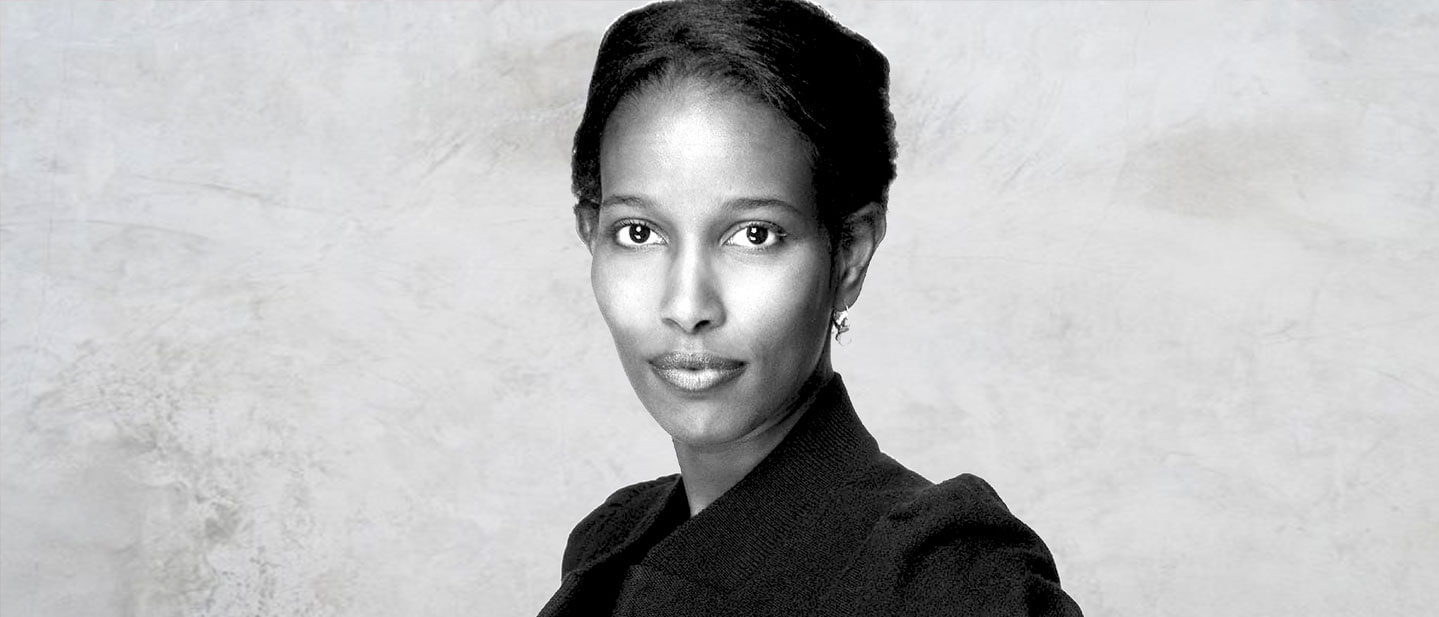
Big Thinker: Ayaan Hirsi Ali
Threatened by Muslim extremists, boycotted by Western activists, Ayaan Hirsi Ali (1969—present) has literally put her life on the line to promote her ideals of rational thinking over religious dogma.
Ayaan Hirsi Ali is a Somali born Dutch American writer best known for her fierce criticism of Islam – the religion of her birth.
She sprung to international notoriety in 2004, when a Muslim extremist killed her Dutch filmmaker colleague Theo Van Gogh, knifing a hand written letter into his chest which called for Hirsi Ali to die next. The extremist targeted the pair for making a film mocking Islam’s treatment of women.
This brush with death only strengthened Hirsi Ali’s resolve to champion her ideals of enlightenment values over religious intolerance. She went on to author four books condemning Islamic teaching and practice.
Fluent in six languages, Hirsi Ali regularly travels the globe on speaking tours, skewering Islam and its local defenders in her articulate, charming style.
She doesn’t appeal to everyone though. The controversial writer has drawn the ire of Muslims and left wing groups who accuse her of anti-Islamic bigotry. Loathed by fundamentalists, she is forced to travel with armed security.
From believer to infidel
Hirsi Ali’s 2006 autobiography Infidel chronicled her extraordinary life journey from devout Somali child to Dutch politician to celebrity atheist intellectual.
Born to a Muslim family, Hirsi Ali says she was five years old when her grandmother ordered a man to undertake a female genital mutilation procedure on her. As a child, she was a believer who read the Qu’ran, wore a hijab and attended an Islamic school.
Looking back, the writer could see all that was wrong with her upbringing – violent beatings, unquestioning faith and rigid enforcement of gender roles.
Hirsi Ali says she sought asylum in the Netherlands in 1992 to flee her father’s attempt to arrange her marriage.
In her new home, the avid reader devoured the writing of enlightenment thinkers like Voltaire, Mill and Locke. These authors taught her to question blind faith and instead embrace science and rational thought.
After working as a translator and researcher, Hirsi Ali was elected to Dutch Parliament in 2002. She used her platform to criticise Islam and Muslim immigration.
Islam ‘is the problem’
Hirsi Ali holds the view that the problem with Islam is not simply a minority of extremists who give the religion a bad name:
“The assumption is that, in Islam, there are a few rotten apples, not the entire basket. I’m saying it’s the entire basket” – Ayaan Hirsi Ali
She argues violence is inherent in the core Islamic text and this is something most Muslims fail to recognise.
According to Hirsi Ali, Muslims can be categorised into three groups.
First, there are “Medina Muslims”, who seek to force extreme sharia law out of their religious duty.
Second, “Mecca Muslims”, are a majority of the faith who are devout but don’t practice violence. The problem with this group, says Hirsi Ali, is they fail to acknowledge or reject the violence in their own religious text.
The third group, “Muslim reformers”, explicitly reject terrorism and promote the separation of religion and politics.
Hirsi Ali argues this third reformer group must overcome the extremists to win the hearts and minds of a majority of Muslims.
Feminist hero or anti-Muslim bigot?
Ayaan Hirsi Ali was initially seen as a feminist activist who championed the cause of oppressed Muslim women. After moving to the US in 2006, she’s associated herself more with right wing groups than women rights’ activists. She became a fellow at the conservative think tank American Enterprise Institute and a regular interviewee on Fox News.
Married to historian Niall Ferguson, the couple have been described as “the Brad Pitt and Angelina Jolie of the intellectual right”.
She has also tweeted her support for Brett Kavanaugh, who was confirmed to the US Supreme Court despite allegations of past sexual assault.
Hirsi Ali’s right wing views and harsh criticism of Islam has seen Western activists target her alongside Muslim fundamentalists.
In 2014, Brandeis University in the US reversed its decision to award her with an honorary degree following objections from students.
In 2017, she cancelled a planned visit to Australia amid security concerns and a petition protesting her speaking appearance.
The Southern Poverty Law Center – a US advocacy group famous for defending civil rights – once categorised her as an anti-Muslim extremist.
Hirsi Ali says she can’t understand why she’s become the enemy:
“It has always struck me as odd that so many supposed liberals in the West take their side rather than mine … I am a black woman, a feminist and a former Muslim who has consistently opposed political violence”.
But if terrorists don’t deter her, activists have no chance. Hirsi Ali will continue to tread her dangerous path to promote what she believes are true liberal values.
Ethics in your inbox.
Get the latest inspiration, intelligence, events & more.
By signing up you agree to our privacy policy



BY The Ethics Centre
The Ethics Centre is a not-for-profit organisation developing innovative programs, services and experiences, designed to bring ethics to the centre of professional and personal life.

In Review: The Festival of Dangerous Ideas 2018

Being tied in a knot of lies, the danger of scepticism, micro-dosing LSD and dismantling bi-partisan politics were just some of the themes threaded throughout this year’s Festival of Dangerous Ideas.
Thousands crossed the threshold into the Festival’s new home on Cockatoo Island. Two days, 31 sessions, and 45 speakers later, they left with a feast of ideas and new perspectives.
For the first time, the island’s unique location and new full-day festival pass meant that you could delve deeper into FODI than ever before.
Caliphate host Rukmini Callimachi shared aching stories of violence and honour in ISIS camps; conservative historian Niall Ferguson forced us all to rethink before we retweet; and pop-culture savant Chuck Klosterman had us empathising with the unlucky aliens who colonise us.
“Hard truths, fleshy realities, blunt edged disagreement and sharp new ideas – all mixed together with a throng of people in an iconic location that spoke alongside the artists and speakers. It was a brilliant amalgam, FODI at its best,” said Dr Simon Longstaff, co-founder, co-curator, and executive director of The Ethics Centre.
For the first time, the island’s unique location and new full-day festival pass format allowed FODI-goers to attend a number of the 31 sessions and delve deeper into different topics and viewpoints while enjoying talks and panels, art installations, ethics workshops and even a touch of cabaret!
Even the master-of-all-trades, Stephen Fry, couldn’t avoid the glamour. A standing ovation roared through Sydney’s Town Hall for his delivery of the inaugural keynote, The Hitch. In honour of his dear friend, the late Christopher Hitchens, Fry had the sold-out venue in oscillating between stitches of laugher and solemn agreement when he lamented the lost art of disagreement in an age of deepening extremes.
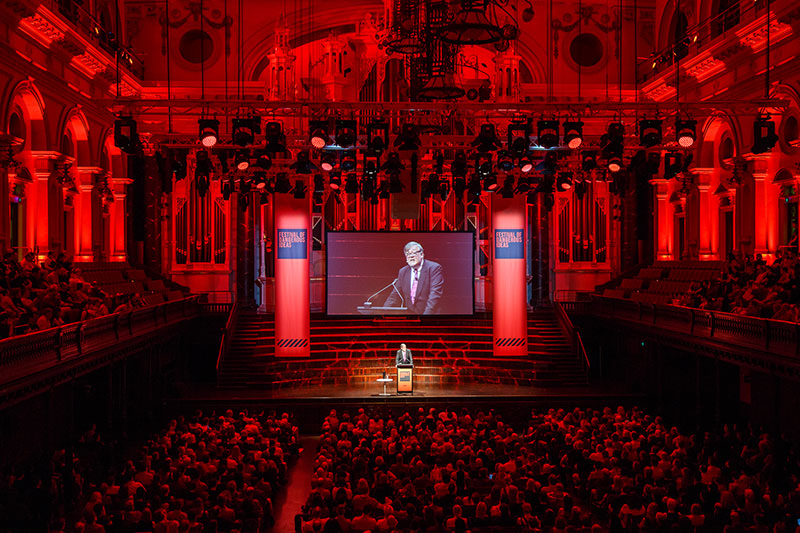
Thinkers from around the globe tackled issues of truth, trust and technological disruption, including Caliphate podcast host and New York Times ISIS foreign correspondent Rukmini Callimachi, British conservative commentator Niall Ferguson, AI man-of-the-moment Professor Toby Walsh, and pop-culture savant Chuck Klosterman.
The sold out festival drew crowds of over 16,500 seats across the weekend, with #FODI trending across social media channels all weekend.
The Centre is enormously proud of this festival which we started a decade ago to provide a space to talk about the issues that divide and baffle us without tearing tearing ourselves and each other apart. And we’re thrilled it’s been a continued success in 2018 with a fantastic new partner, The University of New South Wales Centre for Ideas, and a fitting new home.
If you weren’t able to join us, many of our sessions were recorded and we’ll be releasing them over the coming weeks and months.
We’ll keep you posted in our enews or follow us on Facebook, Twitter, Instagram and LinkedIn for more release updates.
Ethics in your inbox.
Get the latest inspiration, intelligence, events & more.
By signing up you agree to our privacy policy




BY The Ethics Centre
The Ethics Centre is a not-for-profit organisation developing innovative programs, services and experiences, designed to bring ethics to the centre of professional and personal life.

From capitalism to communism, explained
Everything, from your clothes to your phone to the train you last caught, has gone through what economists call ‘the means of production’.
This is the way a commercial good or service is created and sold, all the way from its raw materials to how it arrives in your hands… or to your platform.
Most of these things (also referred to as capital) can only be created as a result of collective effort. No individual can reliably ensure everyone in a country of twenty-five million has a safe way to dispose of their waste or a place to go to when they’re sick. One person can’t even meet the most basic requirement of that population and ensure sure everyone is fed.
Of course, these things cost money to maintain. Whenever cost is involved, people want to know who pays. This is where it gets hairy. If one person owns ‘the means of production’, they have to pay for everything – and keep any and all profit made. If everyone involved owns ‘the means of production’ collectively, they share the cost – and any profit.
This is where the branches of different economic systems begin.
Capitalism
Capitalism is an economic systemwhere the ‘means of production’ and resulting capital are owned by private individuals and businesses. It is based on voluntary relationships of supply and demand instead of centralised (usually government) planning.
This system is rooted in classical liberal philosophy and its conception of the rational, freethinking, autonomous individual. It claims market competition forces people to act in a way that benefits others, regardless of their intention.
Socialism
Socialism is an economic system borne out of opposition to capitalism where the ‘means of production’ are collectively owned and shared. It prioritises production for use rather than profit and achieves this through centralised planning – like a government.
The value of whatever is produced is determined by the amount of time and labour required, not market supply and demand. Socialism claims sharing resources and work according to need, rather than competition, creates a more equitable and secure society.
Communism
Communism is a utopian political economic system where a society is reorganised without hierarchy, states, money or class. The ‘means of production’ are shared communally and private property is non-existent or severely restricted. Karl Marx and Friedrich Engels published the seminal political pamphlet on this, A Communist Manifesto in 1848.
Communism’s modern adherents claim it has not happened yet, while its critics cite Maoist China, Stalin’s Soviet Union, the Cold War, and many other historical crises to signal its danger.
Fascism
Fascism is an economic system based on self-sufficiency of the state, ethnic purity, and one-party ownership over the means of production. There’s usually a dictatorial leader and little to no tolerance of political opposition. Fascism claims the strength of a nation comes from unity and unity depends on fixed identities.
Though commonly associated with Nazi Germany, many other countries have been considered fascist at some point too, such as Brazil, Iraq and Japan.
Laissez-faire
Laissez-faire translates to ‘leave alone’ or ‘let them do’. Laissez-faire is an economic system that leaves transactions and trade free from government regulation, subsidies, tariffs, and privileges. It claims the economy is a natural system and the market is an organic part of it. Government interference hinders something nature can mediate.
Which economic-political system is best?
When discussing what economic system we prefer, it’s important to know what we’re talking about. The economies of most modern countries today are rarely pure capitalism or pure socialism. Most have a mixed capitalist system where private individuals or businesses make profit off labour, while operating within government regulations.
At the bare bones of economic theory, you find philosophy. Questions like ‘What is the purpose of government?’, ‘What is a human right?’, ‘What can we expect from our relationships?’, or ‘What does equality and justice look like?’ inform the different perspectives that manifest into policy.
Which one would you stand for?
Follow The Ethics Centre on Twitter, Facebook, Instagram and LinkedIn.
Ethics in your inbox.
Get the latest inspiration, intelligence, events & more.
By signing up you agree to our privacy policy



BY The Ethics Centre
The Ethics Centre is a not-for-profit organisation developing innovative programs, services and experiences, designed to bring ethics to the centre of professional and personal life.

You don’t like your child’s fiancé. What do you do?
Your child is getting married. A mixture of pride, grief and trepidation have been gathering steam for a while now.
You don’t know how you’re going to feel on the day, but when you see your child go through one of the most ubiquitous rites of passage there is, you can’t guarantee there won’t be tears of love.
Except for one snag.
You don’t like their fiancé.
It’s heartbreaking. What should have been a moment of elation at your child’s joy is soured. You don’t understand why they’re making such a huge commitment to their partner or how you will live with that choice.
Perhaps you don’t think they’re good enough, or you don’t get along with them as much as you’d like. Maybe you see them bringing unhappiness into your child’s life – now or in the future. They might have strange attitudes to parenting or relationships. They might seem plain dangerous. Either way, there’s one question you’re asking…
What should you do?
In this situation, consider what a good parent looks like. Do they support, protect, and nurture their child? Do they allow them to make their own mistakes? Are they honest and fair?
Being honest may mean causing great hurt. Being fair may mean accepting the consequences of your child’s independence. Protecting your child may mean treating your fears as truth. But to what end? And by what means?
Wedding dilemmas splitting you in two? Book a free appointment with Ethi-call. A non-partisan, highly trained professional will help you see through chiffon to make decisions you can live by.
On one hand, what actions present you as the person you want to be? Are they the actions of someone courageous, patient, and wise? Or someone petty, panicky, and controlling?
On the other hand, what actions risk damaging the relationship between you and your child? Or your future child-in-law? What situation necessitates speaking up? Or more drastic measures?
If you decide your concerns aren’t that serious, is there a way you could use this situation to build a stronger relationship with your child and a better understanding of the partner they love?
A lot of the time, when we are faced with an ethical dilemma, we see in binaries. Black or white, either or. Taking the time to slow down our thinking and consider the situation in different ways can help new pathways emerge – even if that means stepping back and living with the decisions another person has made.
So, before you end up expressing your reservations in panic, blame, and threats to boycott the wedding, take a breath. Step back, contemplate who you aspire to be as parent, what actions you feel are right and available to you and get creative.
If you or someone you know is experiencing violence and need help or support, please contact 1800RESPECT. Call 000 for Police and Ambulance help if you are in immediate danger.
Ethi-call is a free national helpline available to everyone. Operating for over 25 years, and delivered by highly trained counsellors, Ethi-call is the only service of its kind in the world. Book your appointment here.
Follow The Ethics Centre on Twitter, Facebook, Instagram and LinkedIn.
Ethics in your inbox.
Get the latest inspiration, intelligence, events & more.
By signing up you agree to our privacy policy


BY The Ethics Centre
The Ethics Centre is a not-for-profit organisation developing innovative programs, services and experiences, designed to bring ethics to the centre of professional and personal life.
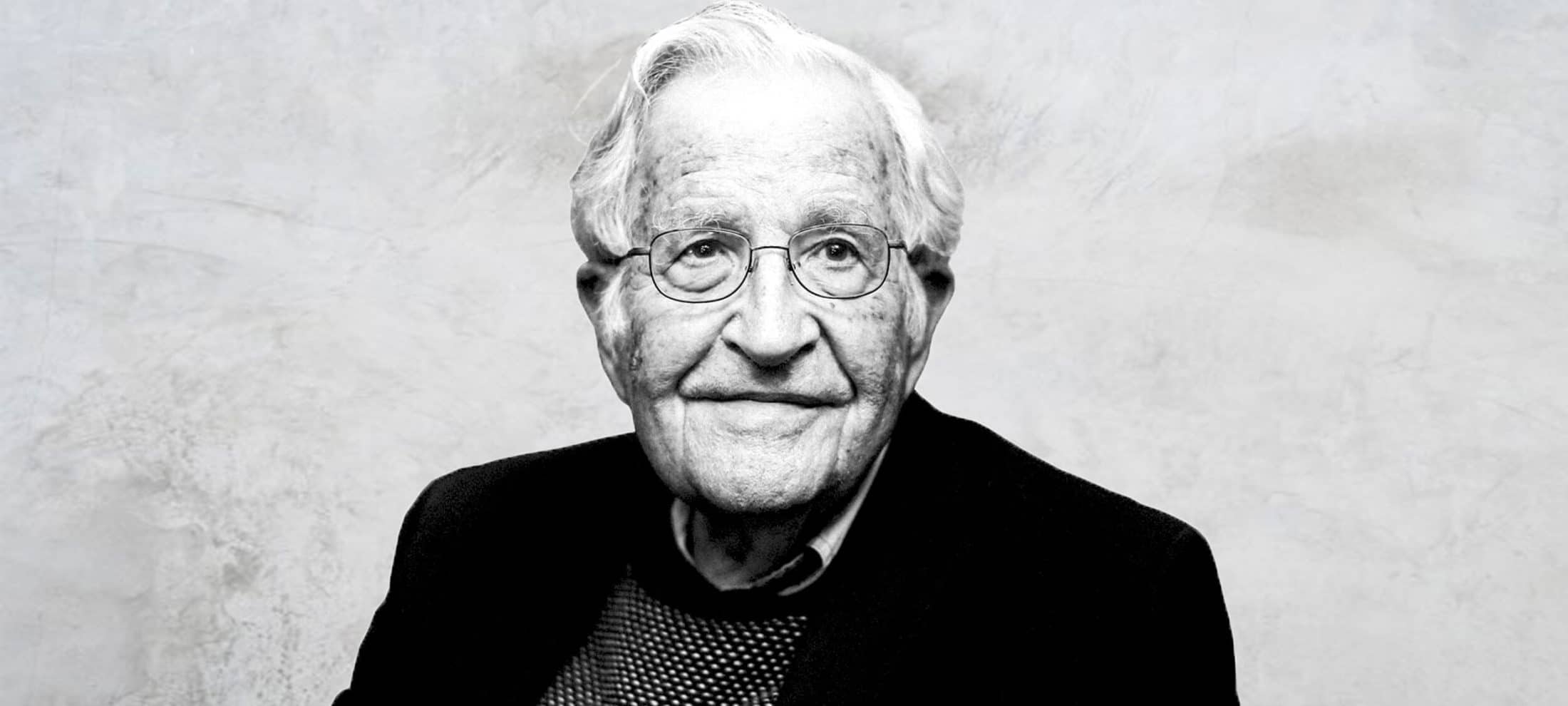
Big Thinker: Noam Chomsky
Noam Chomsky (1928—present) is one of the foremost scholars and activists of our time.
With over a hundred books, thirty honorary degrees, and a generation of aspiring leftists behind him, Chomsky’s life puts a practical lens on the motto ‘protest is patriotic’.
The human tendency towards freedom
Chomsky earned a PhD in linguistics for his theory of “universal grammar”, a theory where all people are “born knowing” shared properties that underpin all human language. These properties, which create what he calls a “language acquisition device”, are what helps babies pick complex languages up instinctively.
According to Chomsky, while language’s laws and principles are fixed, the manner in which they are generated are free and infinitely varied. This view of human nature is one that runs through Chomsky’s attitudes to linguistics or politics: we must protect the innate human tendency towards freedom.
Pessimist of intellect
Chomsky’s opposition to war and totalitarianism started early. He wrote his first paper on the threat of fascism at ten. He opposed the Vietnam War while working at MIT, a military-funded university. He called Gaza the world’s “largest open-air prison” and said the US bears full responsibility for Israel’s war crimes.
Chomsky’s public denunciations of US foreign policy in Central America and East Timor, its interference in Middle Eastern elections and the shoot-first-ask-later’ type of diplomacy have drawn widespread ire and admiration. At the height of his fame in the 70s, it was discovered the CIA was keeping tabs on him and publicly lying about doing so.
Noam Chomsky’s consistent and vocal criticism of the US government comes from the belief that he, as a member of that country, holds a moral responsibility to stop it from committing crimes. That, and it’s far more effective than criticising a government that isn’t responsible for him.
“States are not moral agents; people are, and can impose moral standards on powerful institutions.”
Manufacturing consent
In what is arguably Chomsky’s most famous work, ‘Manufacturing Consent’, he outlined mainstream media’s complicity with government and business interests. He traced the capitalist formula of selling a product at a profit to the highest bidder in relation to the media. Here, people are the product and advertisers are bidding for our attention. Compare this with the monopoly social media has over our time and the ensuing competition for available ad space, and you’ll notice this line of argument growing in prescience.
Chomsky argued the advertising market is shaped by the external conditions of the state. It’s in their best interests to placate their ‘product’ and water down anything that would spur them to act against it. Any dissenting opinion is either ignored or presented as an anomaly. This is anti-democratic, said Chomsky, for a nation is only democratic insofar as government policy accurately reflects informed public opinion.
“If we don’t believe in free expression for people we despise, we don’t believe in it at all.”
Speak truth to power
Fred Halliday, an Irish academic, has criticised Chomsky for overestimating the power and influence of the US. Harvard psychologist Steven Pinker, Oxford historian Stephen Howe, and linguist Neil Smith, have called him a fierce and aggressive moral crusader, who dismisses critics as unqualified, mistaken, or even “charlatans“.
Today, Chomsky is outspoken on what he considers the two greatest threats to humanity: nuclear war and climate change. But with NEG scrapped, the Doomsday Clock inching to midnight, and Congress split, it looks unlikely that decisive action against either of these threats will be carried out anytime soon.
Follow The Ethics Centre on Twitter, Facebook, Instagram and LinkedIn.
Ethics in your inbox.
Get the latest inspiration, intelligence, events & more.
By signing up you agree to our privacy policy