

Virtue ethics
What makes something right or wrong?
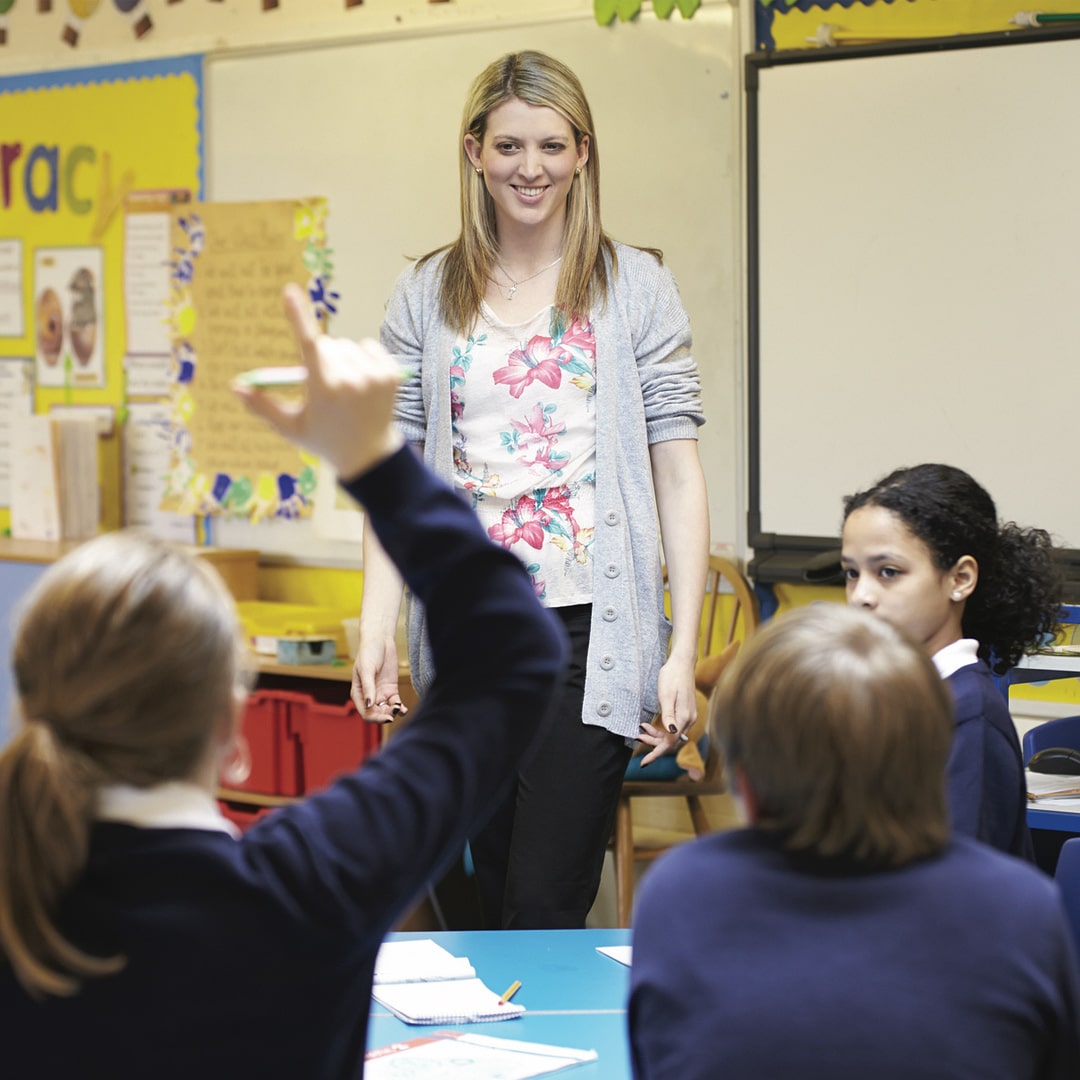
One of the oldest ways of answering this question comes from the Ancient Greeks. They defined good actions as ones that reveal us to be of excellent character.
What matters is whether our choices display virtues like courage, loyalty, or wisdom. Importantly, virtue ethics also holds that our actions shape our character. The more times we choose to be honest, the more likely we are to be honest in future situations – and when the stakes are high.
Ethics in your inbox.
Get the latest inspiration, intelligence, events & more.
By signing up you agree to our privacy policy





BY The Ethics Centre
The Ethics Centre is a not-for-profit organisation developing innovative programs, services and experiences, designed to bring ethics to the centre of professional and personal life.


Deontology
What makes something right or wrong?
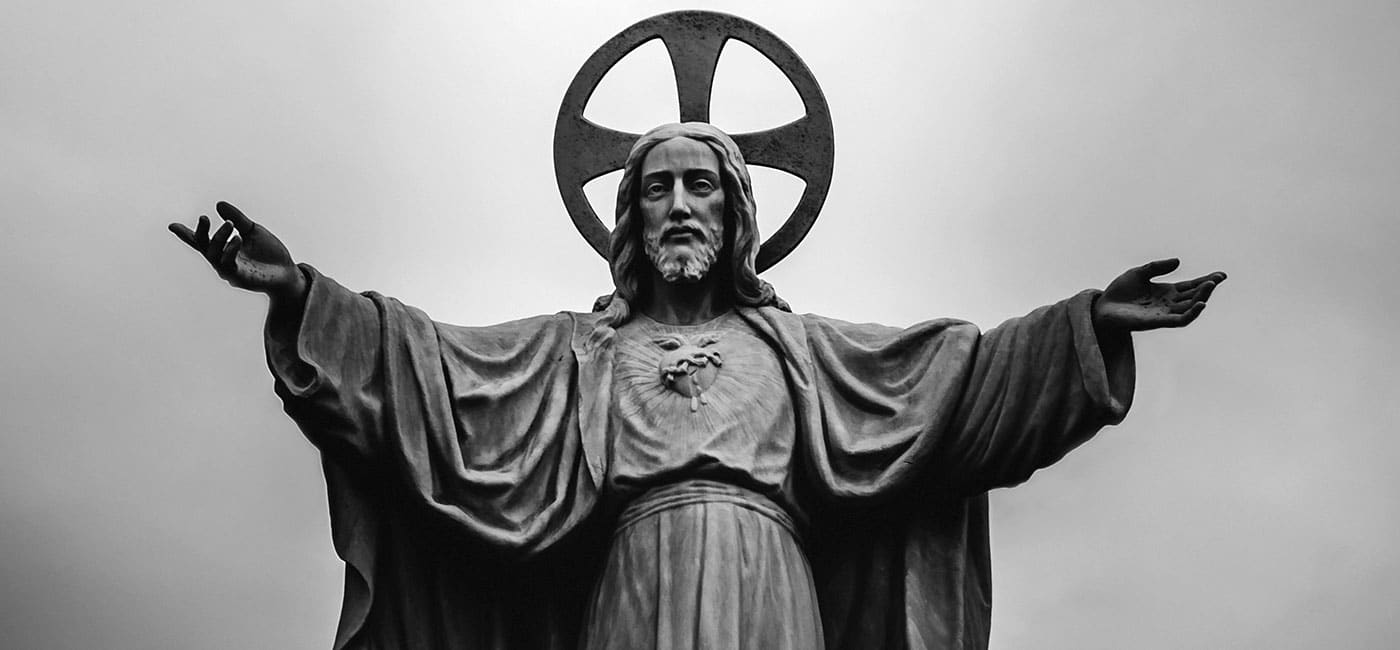
One answer comes from the work of German philosopher Immanuel Kant, who is considered the founder of an ethical theory called deontology. Deontology comes from the Greek word deon, meaning duty. It holds, quite simply, that actions are good or bad based on whether they fulfil universal moral duties.
Ethics in your inbox.
Get the latest inspiration, intelligence, events & more.
By signing up you agree to our privacy policy


BY The Ethics Centre
The Ethics Centre is a not-for-profit organisation developing innovative programs, services and experiences, designed to bring ethics to the centre of professional and personal life.

Consequentialism
For lots of people, what makes a decision right or wrong depends on the outcome of that decision.
Does it increase or decrease the amount of happiness in the world? This kind of thinking is typical of consequentialism: an ethical school of thought that says what makes an action good or bad is, you guessed it, the consequences.
Ethics in your inbox.
Get the latest inspiration, intelligence, events & more.
By signing up you agree to our privacy policy


BY The Ethics Centre
The Ethics Centre is a not-for-profit organisation developing innovative programs, services and experiences, designed to bring ethics to the centre of professional and personal life.

Purpose, values, principles: An ethics framework
An ethics framework is a statement of an organisation’s purpose, values and principles.
It makes clear what they believe in and what standards they’ll uphold. It’s a roadmap to good decision making and, if it’s lived throughout the organisation. It’s also a guide to making an organisation the best version of itself.
Trying to make a decision without knowing your purpose, values and principles, is like being at sea without a rudder. They’ll be pushed around by the winds of our desires, mood, unconscious mind, group dynamics and social norms. The choices they make won’t really be their own.
Ethics in your inbox.
Get the latest inspiration, intelligence, events & more.
By signing up you agree to our privacy policy
You might be interested in…



BY The Ethics Centre
The Ethics Centre is a not-for-profit organisation developing innovative programs, services and experiences, designed to bring ethics to the centre of professional and personal life.

What is ethics?
Ethics asks how we should live, what choices we should make and what makes our lives worth living.
It helps us define the conditions of a good choice and then figure out which of all the options available to us is the best one. Ethics is the process of questioning, discovering and defending our values, principles and purpose. It’s about finding out who we are and staying true to that in the face of temptations, challenges and uncertainty. It’s not always fun and it’s hardly ever easy, but if we commit to it, we set ourselves up to make decisions we can stand by, building a life that’s truly our own and a future we want to be a part of.
Ethics in your inbox.
Get the latest inspiration, intelligence, events & more.
By signing up you agree to our privacy policy




BY The Ethics Centre
The Ethics Centre is a not-for-profit organisation developing innovative programs, services and experiences, designed to bring ethics to the centre of professional and personal life.


Care is a relationship: Exploring climate distress and what it means for place, self and community

As part of their 2023 Ethics Centre residency, researchers Dr Chloe Watfern and Dr Priya Vaughan collaborated with researchers, artists and service providers to explore creative approaches to climate distress, and the ethics of care for place, self, and community in the context of ecological crisis.
Why is it that we are touched most by the things closest to us? Touched, as in, made to feel something strongly, to care in its meanings as both a verb and a noun – to feel concern for and to want to protect or nurture a child, a parent, a special place, a garden, or the bird out the window. It’s a question with an obvious answer. Because they are close. Because they can be felt, sometimes even touched.
Traditional moral theories require us to be unemotional, rational, and logical. For example, we are thought (or urged) to objectively calculate the extent to which our actions will lead to a good outcome for the greatest number of people. However, in the context of our daily lives, an ethics of care highlights the pull of relationships and feelings, like love and compassion, in our moral decision-making.
Tentacle, n.
Zoology: A slender flexible process in animals, esp. invertebrates, serving as an organ of touch or feeling. (Oxford English Dictionary)
The first recorded use of the word “tentacle” in the English language was in 1764, when A. P. Du Pont wrote that “the fingers, or tentacles, end in a deep blue.”
At about this time, the industrial revolution was just beginning in Great Britain, continental Europe, and the United States. Humans in these places gradually, and then very rapidly, moved away from producing things by hand. Coal, iron and water were the core elements of this rapid transformation in societies, extraction and exploitation its drivers. Today, we are at the coal face of its legacy.
Where will all this lead? To a deep blue? To a burning world? To unaddressable environmental collapse? To rubble, ash, and mud?
Care in an era of climate distress
Certainly, we know and feel that the living systems of the earth have been deeply compromised by human activities. This knowledge is a source of intense distress for many of us. At the same time, the collapse of systems creates new and ancient forms of distress, as homes and lives are destroyed or radically altered.
More and more of us care as more and more of us are touched by the effects of our collective actions: biodiversity loss, pollution, global boiling. What might we do with our bare hands, our sentient bodies, to make up for all the loss on our horizon? And where is the horizon anyway?

Professor Timothy Morton refers to global warming, like evolution, or relativity, as a “hyperobject”: something that is very difficult to comprehend using the cognitive tools that we humans have evolved to possess. Climate is everywhere and nowhere, in Antarctic ice sheets and cow belches, in bees and babies, in the cloud and the web, in bushfire smoke and too much (or not enough) rain on a tin roof.
Does Earth’s climate care that it is boiling? We don’t know, because we don’t know how to ask. We can only guess.
Stories of care
During our residency at the Ethics Centre in May 2023, we asked humans to share their stories of care. Colleagues, friends, family members, clinicians, artists, researchers, elders, and knowledge keepers each brought an object that connected to community, self, or planetary care in the climate crisis. These objects – a clay pot, a biodegradable bin bag, leaves collected on country, a handful of seeds – held and evoked memories of grief and loss, but above all, connection with humans, more-than-humans, and places. Close encounters filled with care.
Seeking a way to capture and share these memories, we asked these humans to help us create a tentacular creature: part cephalopod, part bird, part plant, part insect, part fungi, part human, part bacteria, part virus, part landscape.
For us, this tentacular creation was the perfect creature to hold stories of care, responsibility, hope, and fear in the context of our precarious and precious world.
Neither and both human and animal, nature and artifice, Tentacular collapses fictious binaries that have, historically, enabled the climate crisis to be seen as a problem with ‘nature’, rather than the total phenomenon it is.
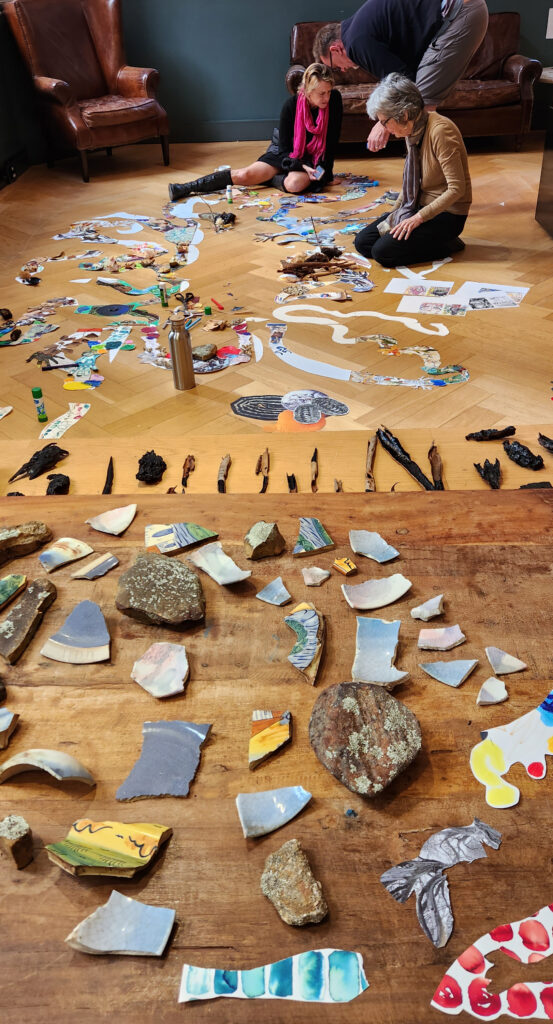
Each tentacle of this collective artwork reaches outwards, seeking connection and offering stories that speak to the ways we might care, in responsible and responsive ways, for ourselves, each other, and the wounded world. Here, we share some evocative snippets from the stories of care that each person offered:
Gadigal, Bidjigal and Yuin elder Aunty Rhonda Dixon–Grovenor grew up being taught to respect and care for country. She tells people “If we are in nature and enjoy it and care for it, then it nourishes us… Care is a relationship, it’s a two-way, it’s not just one person dominating.”
“Care is a relationship, it’s a two-way, it’s not just one person dominating.” – Aunty Rhonda Dixon-Grovenor

Academic Dr Barbara Doran reflects on the tuition of a beehive: “The bees connected me to a more nuanced relationship with nature… Now, I’m more aware of rain, of flowering patterns, of birds: the ecosystem is amplified in my eyes. But after the fires, I’ve noticed an echo-effect. They have been splitting more than they usually do. This year is the first season with no honey. I’m noticing these resonant patterns in a climate changed world. The hive is my teacher, healer and sharpener of antennas.”
Psychotherapist and Group Facilitator at We Al-li, Georgie Igoe asks us to consider threshold experiences: “For me, care means sitting with discomfort and uncertainty, opening ourselves up to the unknown – in the muck, in the grief, not sidestepping it but acknowledging its power.”
Installation artist and theatre-maker Brownyn Vaughan shares the wisdom of her favourite writers and of her favourite swimming place: “The Mahon pool brought me up, it’s my go-to-place… Professor Astrida Neimanis tells us we must stop trying to ascend and transform. Instead, we must submerge, become part of the water.”
Artist-survivor, and lived experience advocate, Lea Richards, mourns and advocates for the mountains: “Snow melt is mountain’s blood. I weep for the glaciers, so far from arid Australia, yet not separate. I imagine connections to those vanishing snows– a flow of water between us. If I conserve this precious blood, can I tend those far places, postpone the melting?”

Embedded in many, perhaps all, of these stories is a conviction that we need to, as Bronwyn said, submerge, to acknowledge our place in the meshwork of the world, and in so doing, to learn with and from the environment. This means burying ego, rejecting a hierarchy where humans are at the apex, and attending in quotidian ways to what is happening to us and around us. Let’s become like tentacles, feeling our way into a better relationship with the world we care so much about.
Tentacular, as part of the exhibition: Care is a Relationship is on display at UNSW Library until 17 November, 2023.
Find out more about The Ethics Centre Residency Program.
Ethics in your inbox.
Get the latest inspiration, intelligence, events & more.
By signing up you agree to our privacy policy




BY Dr Chloe Watfern
Dr Chloe Watfern works across the social sciences, humanities, and creative arts to tackle the big and interconnected challenges of our time, from social inclusion and mental health to climate change. She is currently working at Black Dog Institute (UNSW) and Maridulu Budyari Gumal SPHERE (Sydney Partnership for Health, Education, Research and Enterprise)’s Knowledge Translation Strategic Platform.

BY Dr Priya Vaughan
Dr Priya Vaughan takes an interdisciplinary, and participatory approach to health research, utilising arts-based and socially informed methodologies, knowledge translation (KT) strategies, and interventions to learn about and support mental health and wellbeing. She is currently working at Black Dog Institute (UNSW) and Maridulu Budyari Gumal SPHERE (Sydney Partnership for Health, Education, Research and Enterprise)’s Knowledge Translation Strategic Platform.

Israel or Palestine: Do you have to pick a side?
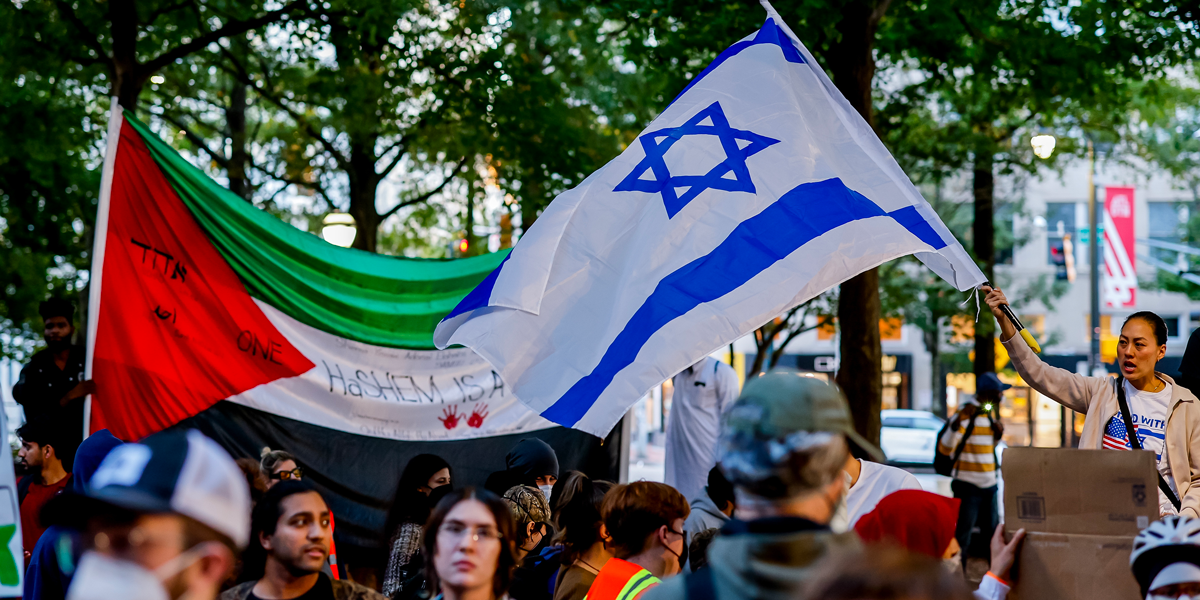
We are inclined to pick a side in complex conflicts, but doing so can diminish our ethical point of view.
In the early hours of 7 October 2023, Hamas launched a barrage of rockets from Gaza into Israel while armed terrorists crossed the border and began a rampage of death and destruction targeting civilians, including children. In the days that followed, Israeli forces retaliated by blockading Gaza, cutting off food, electricity and water supplies, and began bombarding the densely populated city, killing thousands of Palestinian civilians, including children.
When our news screens are filled with footage of such horrors, our moral minds cry out for justice. But justice for whom?
One of the quirks of our moral minds is that we tend to see the world in terms of black and white or good and evil. If we hear about a heinous or unjust act, our sympathies go out to the victims while outrage inspires us to want the perpetrators to be punished. This sorts the world into two categories: the wronged, who deserve sympathy and protection, and the wrongdoers, who are morally diminished or even dehumanised.
Another quirk of our moral minds is that we struggle with ambivalence, which is the ability to see something as being both good and bad at the same time. Once someone – or a group – are painted as the wronged, it’s difficult to also perceive them simultaneously as being wrongdoers in some other capacity. Attempting to do so creates an uncomfortable state of dissonance, and the easiest way to resolve it is to dismiss the troubling thought and collapse things back into black and white.
On top of this we have our personal connections and affiliations, or a sense of shared identity that can cause us to feel solidarity with one side rather than the other. This in-group solidarity is then reinforced through shared expressions of grief and outrage. It is also policed, with any signs of sympathy for the “other side” drawing stiff rebuke.
This is all natural. It’s how our moral minds are wired. So, it’s no surprise that in the case of the Israel-Palestine conflict, many people have already picked a side. But just because it’s a natural inclination doesn’t mean it’s always a healthy one.
Picking a side can shrink our view, making us see the world through that side’s ethical lens and dismissing other possibly valid perspectives.
This is particularly apparent when we’re faced with gaps in the information we receive – as we often are during times of conflict. We tend to fill ambiguity with our own biases, and we seek out information to reinforce our view while discounting evidence to the contrary.
Picking sides can also prevent us from seeing the bigger ethical picture. And in the case of the conflict between Israel and Palestine, the bigger picture is a long history laced with ethical complexities.
However, there is another way. It requires us to acknowledge, but not necessarily follow, our moral intuitions, and instead step back to take a more universal ethical point of view. This is not the same as a neutrality that is indifferent to the claims of either side or to questions of right and wrong. It is taking the side of principle, which is a basis by which we can judge all parties.
Justice for all
Most ethical frameworks offered by philosophers are universalist, in the sense that they apply equally to all morally worthwhile individuals in similar situations. So, if you believe that it’s wrong to kill a particular individual because they’re an innocent civilian, then you should also believe that it’s wrong to kill any individual who is an innocent civilian.
You might justify that in consequentialist terms, such as by arguing that killing innocent civilians causes undue and irrevocable harm, and that the world is a better place when civilians are protected from such harm. You could equally justify it using a rights-based ethics, such as by arguing that all people have a fundamental right to life and safety.
While philosophers have a variety of views on which specific ethical framework or universal principles we ought to adopt, there are some principles that are widely accepted, with many being coded into the Universal Declaration of Human Rights. These include things like a right to life, liberty and security of person, a right to freedom of movement within the borders of one’s state, and that people shall not be arbitrarily deprived of property, as well as a right to the free expression of one’s religion.
The virtue of taking such a principled approach is that is gives us a bedrock upon which we can base our judgements of any action, agent or government. It promotes a sympathetic stance towards all suffering, and aims us towards justice for all, without shying away from condemning that which is harmful or unjust.
It might challenge our partisan feelings that favour the interests of one side over the other, but it urges us to condemn wrongdoing on any side, such attacks targeting civilians or waging war without ethical constraint.
A principled perspective also enables us to navigate complex ethical issues, such as saying that the Israeli occupation of Palestinian land might be unjust, but that it shouldn’t justify Hamas attacking civilians. Or that Hamas’s attacking civilians is clearly morally repugnant, but that shouldn’t justify the collective punishment of Gazans by Israel. And it can allow us to assert that Israel might have a right to defend its territory and citizens from attack, but it – indeed, all parties – must adhere to just war principles, such as proportionality and distinguishing between enemy combatants and civilians. And it ought to reinforce our commitment to seeing a lasting peace in the region, which will inevitably require some compromises on both sides.
Of course, even if everyone agreed on the same set of principles, there will still be substantial differences in interpretation or points of view. A principled stance must also acknowledge that there are fundamental incompatibilities between the interests and demands of both sides that no single ethical framework will be able to resolve without some kind of compromise. For example, when both sides claim certain sites as sacred, and demand exclusivity, there is no way to resolve that without compromise that will be deemed unacceptable to at least one side. However, such uncertainties and complexities don’t undermine the fact that the same universal principles ought to apply to all people involved.
Choosing to side with ethical principle rather than one side or the other is not without its challenges. It forces us to push back on some of our deep moral intuitions and sit with ambivalence and ambiguity. We might be admonished by both sides in the conflict for not backing all their claims, or called a traitor for criticising them. However, the strength is that we can respond to each of these challenges by resorting to the universal principles, compassion and desire for justice that underpins our views on both sides of the conflict.
While the internet and media landscape seem to urge us to take sides in any conflict, it is entirely possible – and often wise – to step back and apply a broader set of principles rather than fall in with a particular partisan perspective. Adopting such a principled stance doesn’t require that you have all the solutions to the conflict, it is sufficient that you have good reason to wish for a just and peaceful solution for all involved.
Image: AAP Photo / Erik S. Lesser
BY The Ethics Centre
The Ethics Centre is a not-for-profit organisation developing innovative programs, services and experiences, designed to bring ethics to the centre of professional and personal life.
Ethics in your inbox.
Get the latest inspiration, intelligence, events & more.
By signing up you agree to our privacy policy



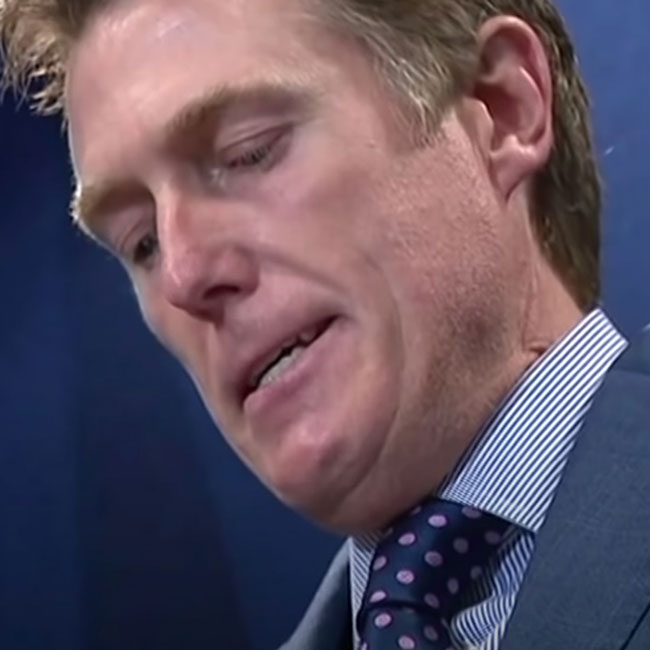

Who are corporations willing to sacrifice in order to retain their reputation?

In an era where mud sticks like glue, corporate tolerance has waned to such a degree that the need to keep hard-fought reputations is outweighing respect for human fallibility.
Careers and hard-won professional reputations built over many decades can come tumbling down overnight after off-the cuff-comments or even private messages sent to a colleague are made public, overshadowing years of hard work.
And the corporations they work for often seek to condemn, seek a resignation and shuffle talent out the door than chalk it up as an error of judgment, forgive and move on.
Tasmanian Attorney-General Elise Archer was forced to resign after one leaked message to the media appeared to be an exasperated reference to victim-survivors of child sexual abuse. Archer was not given the opportunity to challenge the claims made against her and is adamant that the messages were taken out of context.
Another study found 312 news articles about people who had been fired due to a social media post. These included teachers fired after coming out as bisexual on Instagram, and a retail employee let go over a racist post on Facebook.
While racism was the most common reason workers were fired in these news stories, other forms of discriminatory behaviour included posts about workplace conflict, bad jokes, insensitive posts, acts of violence and even political content. Of course, there’s no doubt of dozens more cases that aren’t even made public.
Are companies too quick to condemn?
The blurred lines between knowingly behaving unethically at work and comments shared without our permission raises the question of whether corporations are too quick to condemn indiscretions in favour of their reputation. While public trust in elected officials is critical, it’s also important to remember that these officials are also human beings.
As workplaces are prioritising accountability and ethical standards to ensure safe and productive environments, too often we are seeing errors of judgement costing hard-working professionals their reputation, not to mention their future earning potential after they are ousted from their job.
It begs the question: What ever happened to an individuals’ right to make a mistake and for the rest of society not to leave them out in the cold forever? Have we come to a point where our inner thoughts and feelings shared in private are indicative of our ability to do our job?
Where we draw the line
Despite private messages being made public costing people their jobs and reputations, career coach Renata Bernarde believes that private messages should remain private and usually aren’t a true reflection of our ability to do our job.
“When leaked, we can see that private messages can offer glimpses into someone’s personal thoughts and feelings, which might be expressed without the filter they would use in a professional setting. That said, if private messages reveal behaviours or beliefs that directly contradict the values and responsibilities of their public role, it’s a valid concern. For instance, a diversity and inclusion leader advocating for equality should not have private messages showcasing prejudice.”
However, Bernarde urges corporations to avoid blanket penalties, saying we need to be cautious about using isolated messages out of context to vilify individuals. “It’s essential to consider the entirety of the person’s character and contributions,” she says.
The art of corporate forgiveness
There are occasional cases of corporate forgiveness. Western Australian man Cameron Waugh was charged with six counts of insider trading and was released on bail. He has since appointed the interim CEO of a company that’s obviously deemed his skills more valuable.
While forgiveness and the opportunity to secure a new job after misconduct is complex and multifaceted, human resources and emotional resilience expert Shane Warren says that it’s important that workplaces acknowledge that making a mistake pertains to the psychological and emotional harm caused by actions that violate one’s deeply held moral beliefs.
“Any doctrine of faith reminds us that human fallibility is an inherent part of our nature, and the capacity to make mistakes is universal. The idea that an individual who has ‘stuffed up’ should not be punished indefinitely for errors resonates with our core principles of fairness and modern desire to embrace personal growth.”
However, Warren admits that balancing the need for accountability with the recognition of our humanity can be challenging. Nevertheless, fostering a culture of learning, growth and restorative justice can help strike a more equitable balance between accountability and compassion in any workplace, he says.
The process of forgiveness and reintegration into the workforce should ideally involve steps such as acknowledging wrongdoing, seeking rehabilitation or counselling, demonstrating genuine remorse and showing a sustained commitment to personal growth and ethical behaviour. The timing for a new job may vary depending on individual circumstances and the severity of the misconduct, he says.
“Perhaps instead, society needs to bear in mind that everyone is fallible. If indiscretions or mistakes happen, when addressed and an apology is allowed to be given, it can lead to greater resilience, better understanding and personal and professional development.”
Ethics in your inbox.
Get the latest inspiration, intelligence, events & more.
By signing up you agree to our privacy policy





BY Nina Hendy
Nina Hendy is an Australian business & finance journalist writing for The Financial Review, The Sydney Morning Herald, The Age and The New Daily.

But how do you know? Hijack and the ethics of risk

Hijack, the new Idris Elba-starring miniseries, opens with every airline passenger’s nightmare – a bullet, found in the bathroom of a plane. Within moments, things go from bad to worse.
The ragtag group of heroes, a collection of passengers led by Sam Nelson (Elba), a corporate business negotiator, find themselves in the middle of a hijacking plot, surrounded by criminals, and unable to get help from those down on the ground who, we quickly learn, are ensnared in the plot themselves.
Such a format is not necessarily new – television and film have been littered with stories of hostile airline takeovers, from the big brash action of Air Force One, to the real-world horror of United 93, a tragic retelling of the 9/11 attacks. But what sets Hijack apart is its rapidly escalating sense of dread. Time and time again, Sam and his fellow passengers are faced with impossible decisions, and time and time again, they are foiled. That opening nightmarish feel only deepens – you know those dreams where everything goes wrong; where you are powerless; where the adversaries keep mounting? That’s key to Hijack’s tone, a story of ever-escalating horrors, through which Sam must try to keep himself – and his ethical code – alive.
Indeed, this mounting sense of risk means that Hijack poses an interesting question about ethical deliberation under fire. Sam, who is well-versed in negotiation, but not well-versed in negotiation where the stakes are so high, must repeatedly make rapid-fire decisions. Does he send a text to his wife? Does Sam continue his attempted revolt after he discovers that the hijackers know who his family are, and will kill them if anything goes wrong? Does Sam rush the cockpit? And how responsible will he ethically be if he fails? How much blood is on his hands?
Decision making turned up to 11
The problem of ethical decision-making under fire is essentially the problem of the difference between theory and practice. Sit people down and ask them what the right thing to do is, give them time, don’t hurry them, and psychological studies show that they’ll have a better chance of choosing the ethical answer.
In a famous experiment known as The Good Samaritan, a group of priests-in-training were told to head across a university campus to deliver a speech on the importance of helping others. Some of these priests were given ample time to make it across the campus; others were told they had to rush. Along their trip, the experimenters planted a person in need – an actor, who feigned being sick, and asked for help. The majority of those priests who had been told they weren’t in a rush stopped to help. But the priests who had to move fast, and were stressed and distracted, largely ignored the actor – even though they were literally on their way to give a speech on how to care for their fellow human beings.
The experiment shows that the more that pressure increases – particularly time pressure – the less likely we are to do the right thing. Which poses a significant problem for ethical training. How can you fight against the forces of a chaotic world?
Philosopher Iris Murdoch was aware of the everyday pressures that we meet constantly. For that reason, she considered ethical training a process which prepares us to act unthinkingly. The more we make the right decisions when we do have time, the more likely we are to shape our instincts to be more ethical, and therefore act virtuously when we don’t have time. In this way, Murdoch collapses theory into practice, treating them not as divorced from one another, but with theory informing practice.
Which is a view that Hijack supports. Sam’s cushy day job has given him an unusual set of skills that he himself didn’t even realise that he had. All that work he conducted for years? It was training for this moment.

The ethics of risk
A related issue pertaining to theory and practice is the unknowability of the future. Thought experiments and ethical dilemmas conducted theoretically can have clear right or wrong answers, based on outcomes. But when we’re actually moving through the world, we’re blind to these outcomes. More often than not, we’re stumbling through the ethical world, making decisions based on the hope that things will work out, but never actually knowing if they will.
This is the ethics of risk, extensively covered by the philosopher Sven Ove Hansson. According to Hansson, “risk and uncertainty are such pervasive features of practical decision-making that it is difficult to find a decision in real life from which they are absent.”
Hansson’s solution to this problem is to consider “fair exchanges of risk.” He forgoes the idea that we will never be perfect moral creatures. Because the world is uncertain, we can only ever move towards good ethical actors. There’s no way that we can ever always do the right thing, and nor should we expect ourselves to. Instead, we must try. That is the important part.
So it goes in Hijack. Sam is a flawed main character, who frequently makes errors while trying to save those around him. But we, as audience members, forgive him for this. We don’t judge him for the plans that fail. We see his movement towards good behaviour, and that’s what matters.
In that way, we can also see theory and practice moved out of contention with each other. Theory is the goal; practice is the action. We’ll never live in a fully theoretic state. But what Hijack tells us, is in the face of that impossibility, we should not throw up our hands. We should instead keep moving towards theory – a spot on the horizon that is forever escaping us, but that we never stop chasing.
Ethics in your inbox.
Get the latest inspiration, intelligence, events & more.
By signing up you agree to our privacy policy




BY Joseph Earp
Joseph Earp is a poet, journalist and philosophy student. He is currently undertaking his PhD at the University of Sydney, studying the work of David Hume.

Big Thinker: Karl Marx

Karl Marx (1818-1883) was a philosopher, economist, and revolutionary thinker whose criticisms of capitalism and breakdowns of class struggle continue to influence contemporary thought about economic inequality and the worth of individual labour.
He was not only a prominent figure in the world of philosophy but also a key player in economic and political theory. Marx’s life and work were deeply intertwined with the tumultuous historical backdrop of the 19th century, marked by the Industrial Revolution and the rise of capitalism.
Born in Trier, Prussia (now in Germany), Marx began with a focus on law and philosophy at the University of Bonn and later at the University of Berlin. During his time in Berlin, he encountered the ideas of G.W.F. Hegel, whose methods significantly influenced Marx’s own philosophical approach.
In collaboration with Friedrich Engels, Marx developed and refined his ideas, culminating in some of the most influential works in the history of political philosophy. For example, his infamous The Communist Manifesto (1848) and Das Kapital (1867, 1885, 1894).
Historical materialism and class struggle
One of Marx’s central ideas was historical materialism, a theory that analyses the evolution of societies through the lens of economic systems. According to Marx, the structure of a society is primarily determined by its mode of production: the ways commodities and services are produced and distributed, and the social relations that affect these functions. In capitalist societies, the means of production are privately owned, leading to a class-based social structure separating the owners and the workers.
Marx’s analysis of class struggle underscores the ethical imperative of addressing economic inequality. He argued that under capitalism, the bourgeoisie (owners of the means of production) exploit the proletariat (the working class) for their own profit. This exploitation, he claims, is the engine that drives the capitalist system, where workers are paid less than the value of their labour while the bourgeoisie reap the profits. This exploitation also results in alienation, where workers are estranged from the full effects of their labour and, Marx argues, even from their own humanity.
Marx’s arguments call for a reevaluation of the inherent fairness of such a system. He questions the morality of a society where wealth and power are concentrated in the hands of a few while the masses toil in poverty. This is an ethical challenge that continues to resonate in contemporary discussions about income inequality and social justice.
Marx’s critique challenges us to consider whether a society that values profit and efficiency over the well-being and fulfillment of its members is ethically justifiable.
To address this concern, Marx envisioned a classless society, where the means of production would be collectively owned. This transition, he believed, would eliminate the inherent exploitation of capitalism and lead to a more just and equitable society. While the practical realisation of this vision has proven challenging, it remains a foundational ethical ideal for some, emphasising the need to confront economic disparities for the sake of human dignity and fairness.
Critique of capitalism and commodification
Marx’s critique of capitalism extended beyond its class divisions. He also examined the profound impact of capitalism on human relationships and the commodification of virtually everything, including labour, under this system. For Marx, capitalism reduced individuals to mere commodities, bought and sold in the labour market.
Marx’s critique of commodification highlights the importance of valuing individuals beyond their economic contributions. He argued that in a capitalist society, individuals are often reduced to their economic worth, which can erode their sense of self-worth and dignity. Addressing this ethical concern calls for recognising the intrinsic value of every person and fostering functions in societies that prioritise human well-being over profit.
The communist vision
Marx’s ultimate vision was communism, a classless society where resources would be shared collectively. In such a society, the state as we know it would wither away, and individuals would contribute to the common good according to their abilities and receive according to their needs.
This communist vision raises questions about the ethics of property and ownership. It challenges us to rethink the distribution of resources in society and consider alternative models that prioritise equity and communal well-being. While achieving a truly communist society might be complex or even out of reach, the aspiration of creating a world where everyone’s needs are met and individuals contribute to the best of their abilities is still a general ethical ideal many people intuitively strive for.
Despite this, Marx’s ideas have faced much criticism. Many believe that a classless society with a centralised power risks authoritarianism, Marx’s economic planning lacked detail, communism goes against human nature of self-interest and competition, and historical and contemporary communist systems face large practical challenges.
In spite of, and sometimes because of, these challenges, Marx’s ideas continue to spark ethical discussions about economic inequality, commodification, and the nature of human relationships in contemporary society. His legacy serves as a reminder of the enduring importance of grappling with questions of justice, equality, and human dignity in our ever-evolving social and economic landscapes.
Ethics in your inbox.
Get the latest inspiration, intelligence, events & more.
By signing up you agree to our privacy policy